Do you pick a word of the year? Then you probably know the March moment: scrolling back through your notes app to remember what it was. Sound familiar, gorgeous? Here’s how to actually remember your word of the year, with a little help from psychology.
I don’t think we’re bad at intentions. I think we’re bad at seeing them. So I ran a little merriment experiment: I put my word on my wrist, right where my eyes land a hundred times a day, and wore it for one run until it faded. Here’s what the research says, and how to try it yourself.
Why the sticky note stops working
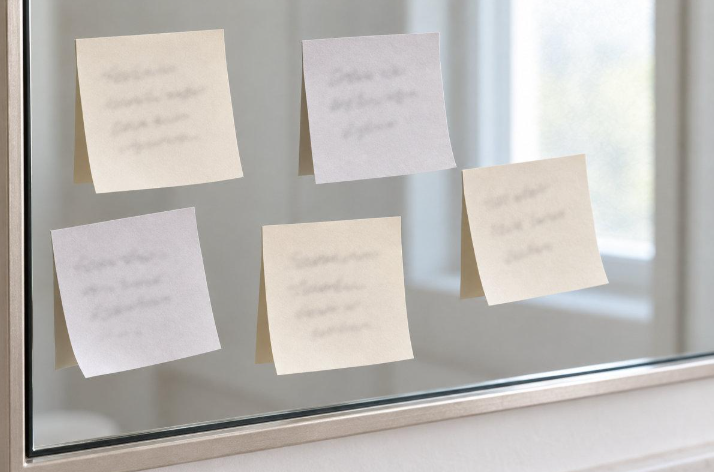
You’ve done this. You write the word on a sticky note, put it on the mirror, and by Thursday you walk right past it. One member of an ADHD community on Lemmy described it perfectly: “After a while, it just becomes part of the decor and I completely ignore it” (Lemmy).
This is completely normal! Psychologists call it sensory adaptation: “we often don’t perceive stimuli that remain relatively constant over prolonged periods of time” (OpenStax Psychology 2e). Your brain simply filed the note under furniture.
Why a cue tied to a moment works better
Here’s the good news. In a meta-analysis of 94 independent tests, Peter Gollwitzer and Paschal Sheeran found that “if-then” plans (“if it’s 3 p.m., then I take a walk”) had a medium-to-large effect on actually reaching goals (University of Konstanz). The plan works because the moment itself does the reminding.
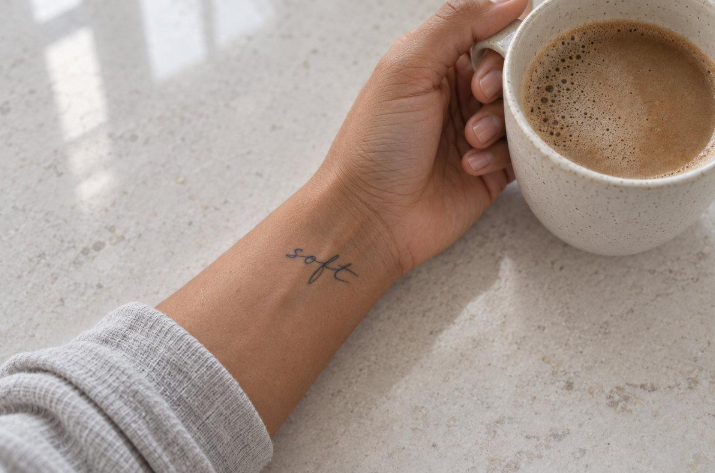
A word on your wrist turns everyday moments into that “if.” If I reach for my coffee, then I see “soft,” then I unclench my jaw. And unlike the mirror, your wrist moves. It drifts in and out of view all day, into new moments, which (my guess) makes it harder to file under furniture.
One honest catch: a review by habit researchers Wendy Wood and Dennis Rünger notes that passive reminders like physical signs are “helpful in prompting initial repetition” but “ultimately lost potency over time” (Wood & Rünger, 2016). So treat it as a run, with a start and an end, and then a fresh word.
How to run the experiment
- Pick one word for one pattern. Think of it as an invitation: “rest,” “play,” “enough,” “soft,” “now.” Pick the word you need this month. I chose “soft” because I’d spent the winter braced for everything: shoulders up, jaw tight, answering every email like it was an emergency.
- Write your if-then. “When I see my wrist, I ____.” Keep it tiny: one breath, one text to a friend, one stretch. Mine was “When I see my wrist, I drop my shoulders and take one slow breath.”
- Put it on your skin, not on a note. I made mine with JUSTPRESS: I wrote the word in my own handwriting, photographed it and uploaded it, then chose the size. It’s semi-permanent, so it develops over 24–48 hours into a blue-black shade, close to tattoo ink, and has a tested wear range of 4–22 days depending on the spot. On the wrist that’s 7–13. Hello, perfect experiment length!
- Make it readable. Put one short word (up to about six letters) straight across the inner wrist, about 2 × 0.6 in. If it’s script or handwriting, keep the lowercase letters about 0.3 in tall, or it’ll blur into a squiggle. Longer words fit better on the forearm.
- Keep a one-line log. Each night, write down when it caught you.
- When it fades, swap. Keep the word, change it, or let it go. A new word gives your brain something new to notice.
What happened
- The first days: It looked faint when I peeled the film and darker by the second day. After that I noticed it constantly. A little strange, then lovely.
- The middle: It started catching me at the right moments. In the middle of a rushed morning, it said “soft,” and I actually dropped my shoulders, took one slow breath and answered the email an hour later instead of right away!
- As it faded: I kept glancing at the spot where it had been, and I noticed I was still doing the breath. The word faded; some of the habit stayed. Next run, I’m trying “play.”
If you’ve ever wanted a word tattoo and stalled at the permanent part, you’re in good company. I’m not tattoo-shy: Ariel has lived on my foot since 2013. A word is different. It has to be the right word. Blogger Alli Polin kept the word “in my wallet on a piece of paper” instead (Break the Frame), and a commenter on the same post admitted, “I’m too fickle for that.” This experiment is for both of them: a word you can see, for a run you choose.
What one word would you wear?