
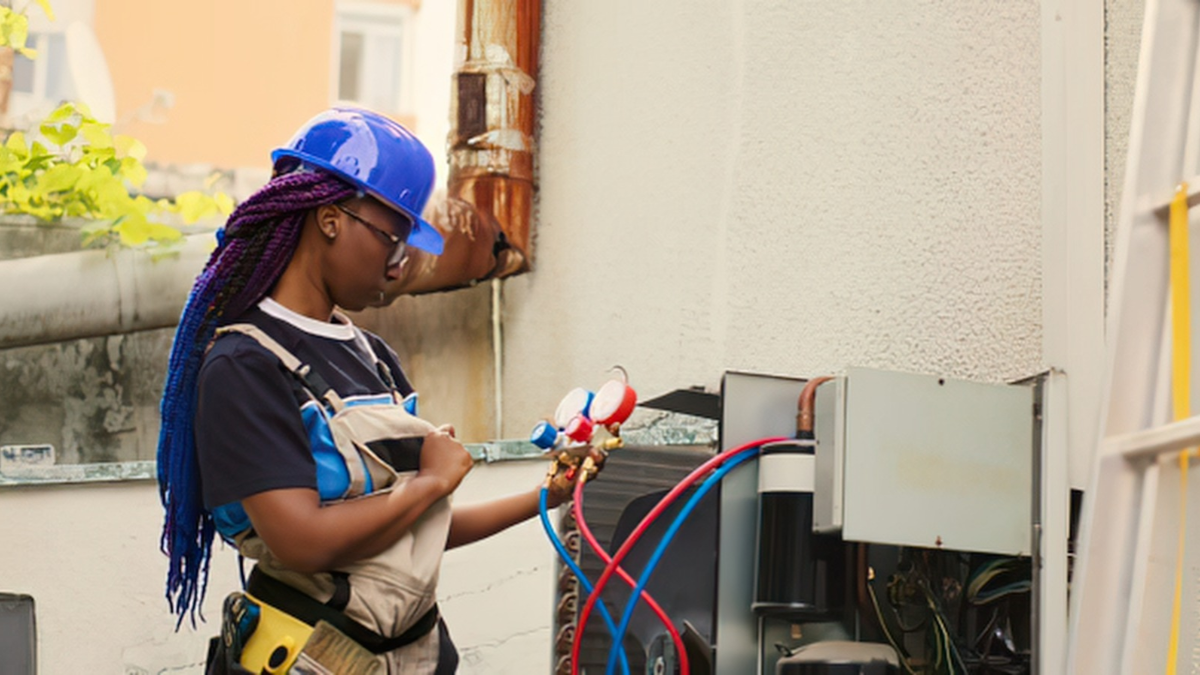
The first hot day of the year is when most cooling systems get their first real test, and that is the worst time to find a problem. Technicians are booked for days, and the fault is often something an owner could have spotted in March: a filter grey with dust, a sofa over the return grille, leaves packed against the outdoor coil.
Seasonal HVAC checks take less than an hour twice a year. Here is what to check, how to read a fault code, and where the York, McQuay and Trane manuals fit in.
Find the right manual before seasonal HVAC checks
Every component has a data plate with its manufacturer, model number and serial number. A split system often has three different ones: the indoor unit, the outdoor unit and the thermostat. They may not even share a brand, so record each plate separately.
The three brands also sit inside larger companies today:
| Brand | Owner today | Typical equipment |
| York | Johnson Controls | Residential and commercial heating and cooling |
| McQuay | Daikin, sold as Daikin Applied | Mainly commercial: chillers, rooftop and terminal units |
| Trane | Trane Technologies | Residential and commercial systems |
For York equipment, search the york manuals directory with the full model designation from the plate.
McQuay documents are often written for commercial units, so match both the equipment type and the model number in mcquay manuals before you rely on one.
Trane publishes owner documents separately from installation and service ones. Use trane manuals to find the one that lists your model.
Which part of the manual is yours
The owner’s manual covers filters, thermostat use and routine care. Installation and service manuals describe electrical and refrigerant work, plus gas connections,, which belongs to a licensed technician. If a directory copy does not list your exact model, ask the manufacturer or your installer.
Check the filter first
A clogged filter is the most common cause of weak airflow, and the cheapest one to fix. According to the US Department of Energy, a fresh replacement for a clogged one can cut an air conditioner’s energy use by 5% to 15%.
Fit the right one
- Switch the system off at the thermostat if the manual says to.
- Photograph the old filter in place before removing it.
- Read the size printed on its frame and buy the same size.
- Fit the new one with the arrow pointing in the direction of airflow, toward the blower.
The arrow shows airflow, not “up.” A filter that is loose in its slot lets air bypass it, and a thicker filter than specified can restrict airflow. Change the thickness or efficiency rating only if the manual allows it.
How often to replace it depends on the filter type, pets and how hard the system runs. Check it every month in peak season until you know how fast it loads up.
Clear airflow inside and out
Walk through the house and move furniture and curtains away from supply and return registers. Closing vents in unused rooms rarely saves energy and can upset the design airflow.
Outside, clear leaves, grass clippings and stored items from around the outdoor unit. Keep the clearance stated in the manual. Do not open panels or reach inside the unit.
If airflow is still weak with a clean filter and open registers, the cause may be in the ductwork, blower or coil. That is a service call.
Test the thermostat before the season starts
Testing the thermostat early separates a settings problem from an equipment fault:
- For cooling, select Cool and set the temperature a few degrees below room temperature.
- For heating, select Heat and set it a few degrees above.
- Wait. Many systems have a built-in delay of several minutes before the compressor or burner starts.
Check the outdoor temperature limits in the manual before testing cooling on a cold spring day. A blank display on a battery thermostat usually means flat batteries. If fresh ones do not help, call for service rather than investigating the wiring.
The Department of Energy estimates that setting the thermostat back 7 to 10°F for eight hours a day can save up to 10% a year on heating and cooling.
Use a spring and fall checklist
| Season | Owner check | Escalate if |
| Spring | Filter, outdoor unit clearance, cooling test | No cooling after the documented delay |
| Summer | Filter monthly, condensate drain line visible and clear | Water around the indoor unit |
| Fall | Filter, registers, heating test | No heat, or a burning smell that does not fade |
| Winter | Snow and ice clear of a heat pump’s outdoor unit | Ice that stays after a defrost cycle |
A heat pump that briefly stops its fan and releases steam in winter is usually running a normal defrost cycle. A coil that stays encased in ice is a fault.
An owner’s checklist does not replace the professional maintenance the manufacturer specifies, and some warranties depend on it.
Read a fault code without guessing
Write down the exact code or blink pattern, which device shows it and that device’s model number. Codes are not interchangeable between brands, or between the thermostat and the unit.
Record it properly
- Photograph a code that stays on the display.
- For a blinking light, take a short video or count the flashes and note the color.
- Note what the system was doing when the code appeared.
Do not reset a lockout over and over. It is a protective response, and repeated resets can restart the equipment with the fault still there. Never bypass a protective switch or open an electrical panel.
Gas and carbon monoxide
If you smell gas or a carbon monoxide alarm sounds, leave the building at once and call 911 from outside. For a suspected gas leak, also call the gas utility. Do not operate switches or stay inside to find the cause. Every home with a gas furnace should have working carbon monoxide alarms.