
The short answer is: harder than most people expect, less hard than some accounts make it sound, and harder in specific ways that you can actually prepare for rather than just endure.
The problem with the reputation is that it comes from two populations with opposite biases. People who found it genuinely difficult share that experience in detail because it surprised them. People who found it manageable don’t write as many posts about it, because “I hiked a volcano and it was fine” doesn’t generate much engagement. The result is an information environment that slightly overweights the suffering dimension relative to the actual distribution of experiences.
That said, if you’re asking whether Acatenango is hard: yes, it is.
What Makes It Hard
The difficulty is physical in specific and somewhat unusual ways. The trail doesn’t require any technical skill. There’s no exposure, no scrambling, no sections that would cause anxiety for anyone without a fear of heights. It’s a walking trail that goes uphill for a very long time on a surface that makes every step less efficient than it would be on firm ground.
The volcanic ash and loose scree that covers the upper sections of the trail shift underfoot with each step. On firm ground, your foot pushes off and the ground holds. On this surface, some of that energy goes into compressing and displacing the substrate instead. The caloric cost of climbing on loose ash is higher than the same gradient on a normal trail, and it’s more demanding on stabiliser muscles that most people don’t train specifically.
The altitude hits differently depending on what you’re coming from. Most people doing the Acatenango hike from Antigua have been in the city for at least a day or two, which helps somewhat since Antigua itself sits around 1,530 metres. But the summit at just under 4,000 metres is a different proposition from anything you’ll have experienced around Antigua. Above 3,000 metres, most people notice their heart rate running higher than the exertion level would normally produce, and the air feels thin in a way that’s difficult to describe to someone who hasn’t experienced it.
The cold at the high camp is the third component. You’ve done a hard afternoon of hiking, you’re tired, you’ve eaten your camp dinner, and now you need to sleep on the ground at temperatures that can drop well below zero. Then you wake up a few hours later, still tired, to summit in the dark. This is the part that most people find hardest in memory, partly because it’s genuinely cold and uncomfortable and partly because it comes when your physical reserves are lowest.
What Makes It Not As Hard As The Worst Accounts
It’s a marked trail with a guide. You’re not navigating, you’re not making route-finding decisions, you’re not managing the logistics of a serious backcountry experience. You follow your group, you put one foot in front of the other, and the trail eventually reaches the top. The psychological simplicity of this is underrated as a difficulty reducer.
The pace is genuinely manageable if you allow yourself to go slowly. This is where most of the fear-generating accounts diverge from the typical experience: people who found it brutal were often in groups that moved faster than they should have, particularly in the early sections where the trail feels easy and the altitude hasn’t started biting. Going slowly and sustainably, ignoring any social pressure to keep up with faster group members, dramatically changes how the upper sections feel.
The descent, which sounds like it should be the easy part, is actually where most post-hike knee complaints originate. Loose ash going downhill produces a slipping stride that puts significant load on the knees over several hours. Poles help, pace helps, and people who have any knee vulnerability should take this more seriously than the ascent difficulty.
The overnight section is uncomfortable rather than unsafe. Cold, hard ground, probably broken sleep, possibly a headache from the altitude. None of this is dangerous for a healthy person with the right gear. The right gear matters, which is why articles about what to bring for this hike spend so much time on the sleeping bag and layering questions.
The Honest Comparison Points
For hikers who have done other well-known multi-day trails, Acatenango’s one-night format is considerably shorter in duration but the altitude and vertical gain in a short distance make the ascent day more intensive than a typical day on, say, the Camino de Santiago or the Inca Trail acclimatisation stages.
If you’ve hiked at altitude before, you have a reference point. If you haven’t, the altitude effect is the least predictable variable of your experience and the one most worth taking seriously.
For hikers who don’t have a significant hiking background, “what’s your current fitness level” is the most relevant question. Someone who walks regularly but hasn’t done multi-hour uphill hiking will find it hard in the final sections of the ascent. Someone who does no regular exercise will find it very hard. Someone who has trained specifically with loaded stair climbing for several weeks will find it manageable and may find the experience exhilarating rather than primarily exhausting.
What the Experience Is Actually Like
The ascent happens in the afternoon, which means you start in reasonable heat and finish in cooling temperatures. The first hour feels deceptively manageable. The second hour is where people start to spread out based on pace and fitness. The third and fourth hours, as you approach the high camp, are the ones where the altitude and the gradient and the surface combine into something genuinely demanding.
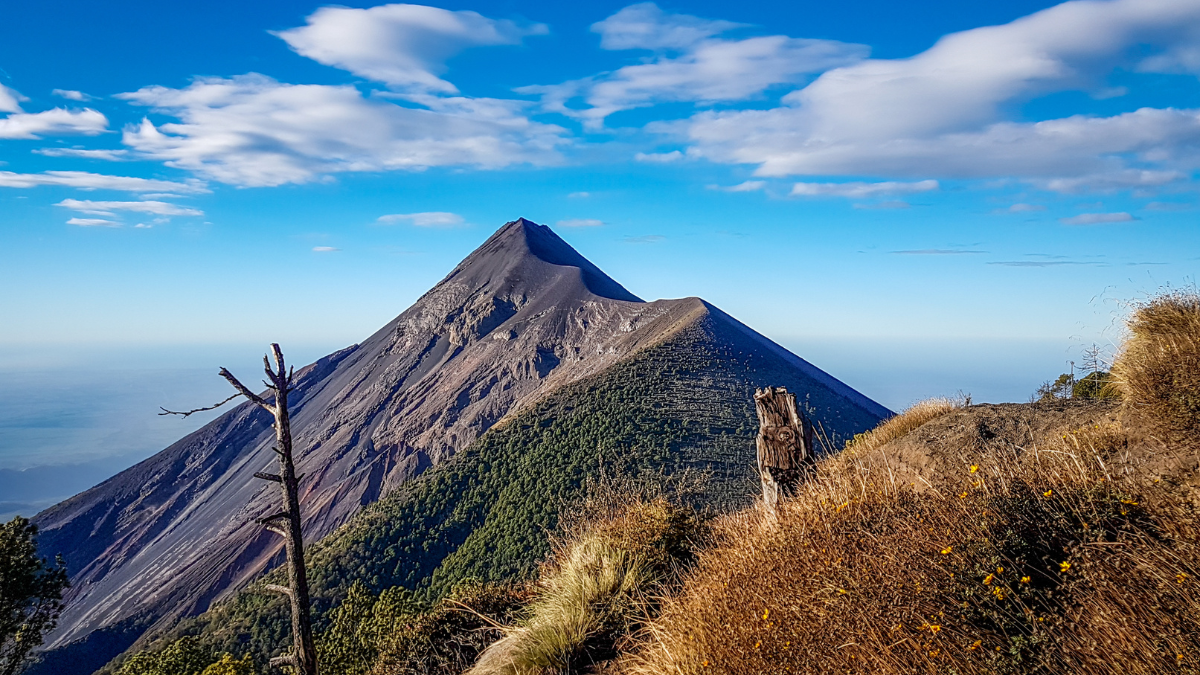
The high camp, when you reach it, is the best moment of the afternoon. You’re done ascending for the day, there’s hot food coming, the view of Fuego erupting in the near distance is one of the stranger and more beautiful things you can see from land, and the satisfaction of having made it this far is real and deserved.
The summit push in the early morning is two hours of cold and effort rewarded by a sunrise view from nearly 4,000 metres that justifies the entire experience. Not everyone makes the summit, and turning back is always the right decision if conditions or health require it. But the people who make it consistently describe it as one of the more memorable mornings they’ve had.
The descent is four to five hours of loose ash walking that’s easier on the lungs and harder on the knees than the ascent. The trail that was so serious going up feels almost playful going down, in sections, because the loose surface lets you jog and slide on the steeper bits in a way that’s genuinely fun once you’ve accepted that your boots are going to be full of ash.
Who Should Do It and Who Should Think Twice
Do it if you’re reasonably active, have at least a few weeks to train specifically for it, can spend two or three days in Antigua for acclimatisation beforehand, and have gear appropriate for the cold. The Acatenango hike from Antigua is hard but it’s absolutely within reach of ordinary hikers who prepare properly.
Think twice if you have significant knee problems, a history of altitude sickness at lower elevations, heart or respiratory conditions that altitude would exacerbate, or genuinely no fitness base and no time to build one. None of these are absolute disqualifications, but they warrant specific advice from a doctor rather than generic trail guidance.
The mountain is hard. It’s also worth it. Most people who do it say so, which is the most reliable endorsement available.