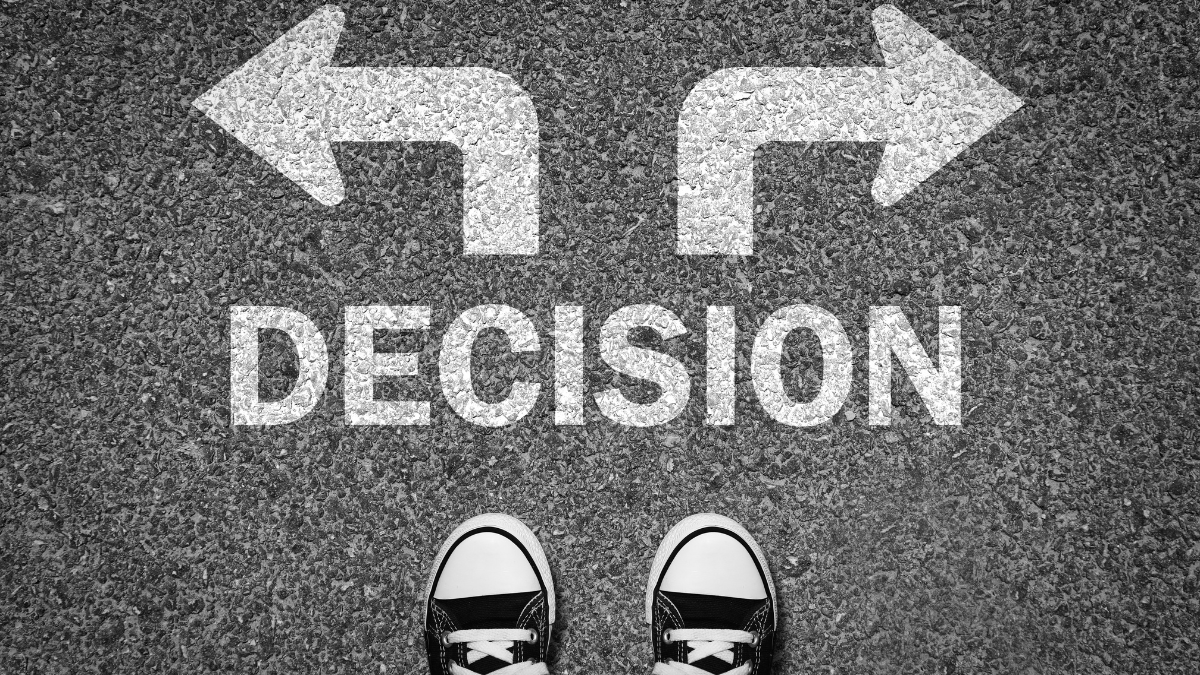
Fast decisions do not just end uncertainty. They create room. Most people think of a decision as a closing door, and that is true to a point. The moment you choose, you give up other paths. But that is not always a loss. In many parts of life, especially when stress is high, shrinking your options is exactly what allows you to move, think, and learn again. A messy middle with endless possibilities can feel productive, but often it is just mentally expensive.
A fast decision can be useful because it replaces vague worry with a real next step. That matters whether you are choosing a job lead, setting a household rule, or deciding how to handle money pressure. If your finances are weighing on you, even starting to explore debt relief can turn a giant fog of “maybe” into a smaller set of concrete choices. That does not solve everything in one shot, but it does something powerful. It gives your brain a place to stand.
The hidden benefit of deciding quickly is not speed for its own sake. It is that action creates information. Before you choose, you are guessing about outcomes. After you choose, you begin collecting evidence from real life. That evidence is often more valuable than another week of overthinking.
Why too many options can quietly drain you
People usually talk about choice as freedom. More options, more control, more chances to get it right. But in daily life, too many live options can create friction. Every open possibility demands attention. Every unmade choice asks for another round of comparison. You start evaluating instead of living.
This is why a simple decision can feel like a wave of relief. The relief is not always about being sure you picked the perfect answer. It is about no longer carrying ten imaginary futures in your head at once. When you decide, you stop renting out mental space to roads you are not taking.
That is especially true with personal goals. If you are trying to get healthier, improve your budget, or fix a stressful routine, keeping twenty plans on the table can become its own form of avoidance. You tell yourself you are still “figuring it out,” but what you may really be doing is protecting yourself from the discomfort of committing.
Commitment teaches faster than contemplation
There is a practical reason fast decisions can be smart. Reality gives better feedback than speculation. You can sit with a notebook and rank pros and cons for days, but at some point, only action will show you what actually works in your life.
This idea shows up in structured approaches to decision making, which emphasize examining alternatives, making a choice, and then learning from the results. The basic process is not about waiting forever for perfect certainty. It is about moving forward with the best available information and improving from there. Illinois Extension’s guidance on difficult decisions also stresses thinking critically, checking for missing facts, and learning from past errors, which is a useful reminder that progress depends on reflection after action, not just reflection before action.
In other words, the value of a decision is not only in the answer. It is in the feedback loop that starts once the answer is tested.
The real enemy is often decision residue
One underappreciated problem is decision residue. That is the mental drag created by choices that are technically available but practically unresolved. You keep revisiting them in the shower, while driving, or at 2 a.m. when your mind suddenly wants to review every possible scenario.
Fast decisions cut down that residue. They tell your mind, “We are doing this now.” That frees attention for the work that follows. Instead of asking, “What should I do?” you get to ask, “How do I make this work?” That second question is usually more useful.
This is not an argument for reckless choices. It is an argument for recognizing when extended deliberation has stopped being helpful. If you already understand the stakes, know your basic values, and have enough information to avoid obvious mistakes, more delay may not improve the outcome much. It may just increase your stress.
Smaller options can make you more adaptable
It sounds backward, but reducing your options can make you more flexible. When everything is still undecided, you are not adapting. You are hovering. Adaptation begins after commitment, when you respond to what the real world gives back.
This is a core idea in decision making under uncertainty. In fields where people cannot know everything in advance, action and monitoring are often part of the learning process. The U.S. Forest Service has described how structured decisions and follow up learning help people compare alternatives, manage uncertainty, and improve future choices. You can see that same logic in everyday life. A budget is not final truth. It is a test. A career move is not a prophecy. It is a data point. The U.S. Forest Service’s discussion of decision processes reflects this broader principle that decision making improves when choices are connected to observation, adjustment, and continued learning.
That mindset is incredibly helpful when a decision feels heavy. You do not have to treat every choice as permanent proof of who you are. Many decisions are better understood as experiments with consequences. Serious ones, yes, but still experiments that teach you something.
Fast does not mean careless
The best fast decisions are usually built on a few stable filters. What matters most here. What is reversible. What can I learn quickly. What risk is acceptable. Those questions help you move without pretending uncertainty has disappeared.
For example, if a choice is reversible, there is less reason to agonize over it. If it is high impact and hard to undo, then it deserves more care, but still not endless spiraling. You gather solid facts, choose a direction, and let experience sharpen your next move.
This approach is especially useful in financial stress, because anxiety loves open loops. When bills, balances, and deadlines are hanging over you, leaving every possible strategy alive can make the problem feel larger than it is. Choosing one reasonable next step, even if it is just making a call, reviewing a statement, or getting professional information, shrinks the emotional size of the problem.
A closed door can be a clean beginning
We tend to romanticize open doors. But a closed door has its own gift. It lets you stop auditioning lives you are not living. It lets effort collect in one place. It turns identity from a theory into a practice.
That is why fast decisions can be so effective. They narrow the field, but they widen your ability to act. They remove some possibilities, but they increase contact with reality. And once reality enters the picture, learning gets faster, fear gets more specific, and progress becomes easier to measure.
So yes, fast decisions shrink your options. That is exactly why they can move your life forward. They trim the branches so the tree can grow where it is rooted. They replace endless possibility with useful momentum. And in a world where mental energy is limited, that is not a small advantage.