
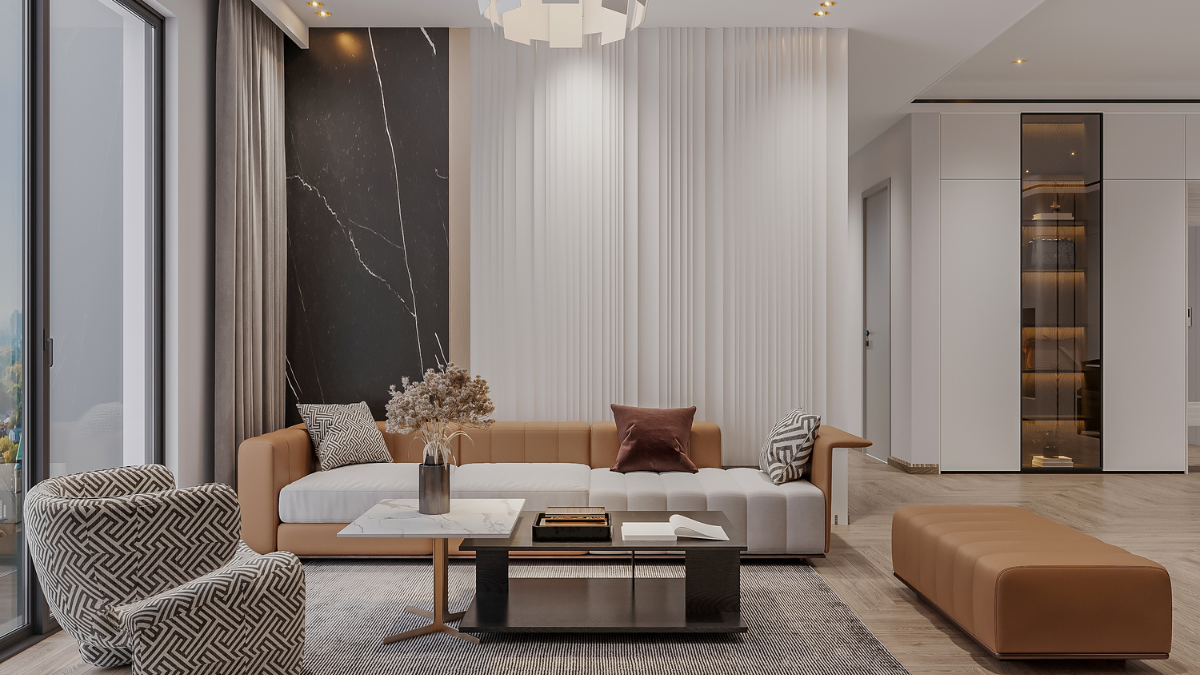
There’s a particular kind of fatigue that comes from walking into a beautifully finished home and feeling like you’ve seen it before. The limewash walls, the japandi-adjacent furniture, the linen everything. It’s not bad. It’s often genuinely well done. But it’s also clearly assembled from the same aesthetic vocabulary as the last several homes you visited, the last hotel you stayed in, and about forty percent of the interior design content currently circulating online.
That fatigue is part of what’s driving serious interest in bespoke interiors at the luxury end of the market. Not just custom-made furniture or handmade tiles, but projects where the entire approach, the spatial planning, the material selection, the proportions of every room, is developed from scratch around the specific people living in the space rather than applied from a current aesthetic template. The distinction between a well-executed on-trend interior and a truly bespoke one is real, and it’s increasingly the distinction that clients who have experienced both are willing to pay for.
The Limits of the “Luxury” Label
Luxury in interior design spent a long time meaning expensive materials and prestigious brands. Marble, silk, French and Italian antiques NZ, antique furniture, known names from the design world applied to surfaces and furniture throughout. This version of luxury still exists and still commands significant budgets, but it’s running into a credibility problem.
When the same premium materials appear in high-end hotels, airport lounges, flagship retail environments, and residential projects across the globe, they stop functioning as signals of individuality and start functioning as signals of expenditure. A Calacatta marble kitchen in 2025 communicates that money was spent. It no longer communicates much else, because Calacatta marble kitchens are in so many places that the material has lost its distinctiveness. The same is true of a long list of materials and pieces that defined luxury interiors a decade ago and are now simply the background of expensive hospitality spaces everywhere.
The clients responding to bespoke interiors are often reacting to exactly this problem. They’re not interested in a home that announces its budget through the deployment of recognised luxury signals. They want a home that couldn’t belong to anyone else, and that ambition turns out to require a genuinely different design process, not just a more expensive version of the same one.
What Bespoke Actually Requires
The word bespoke has been stretched to cover a lot of ground it doesn’t quite deserve. A kitchen with custom cabinet sizes isn’t bespoke in any meaningful sense. Neither is a project where a designer applies their signature aesthetic to a new client’s home and specifies everything on their preferred supplier list. The word has started functioning as a premium price signal rather than a description of how the work was actually done.
A genuinely bespoke interior starts from the specific. Who are these people? How do they actually spend their time at home? What do they own that they care about, and how should the space relate to those objects? What kind of light do they want to wake up in? Do they need a home that functions as a social space, a private retreat, or both? None of these questions have standard answers, and the design can’t proceed properly until they’ve been worked through.
This is a more intensive process than working from a template, and it takes longer. The material and product selection often involves commissioning work from craftspeople and makers rather than specifying from catalogues. The spatial decisions are made against the specific brief rather than against generic residential planning principles. None of this is impossible, but it requires a particular kind of designer and a particular kind of client relationship, and it produces something that genuinely couldn’t have been produced for anyone else.
Craftsmanship and the Return to Making
One of the consistent characteristics of bespoke interior projects is the involvement of makers: furniture makers, textile designers, ceramic artists, metalworkers, joiners working from hand-drawn details rather than standard profiles. This is partly an aesthetic choice and partly a logical consequence of the bespoke approach.
If a room needs a specific console table at a specific height with a specific relationship to the window beside it and the objects that will sit on it, the options are to find something existing that meets all those requirements, which is unlikely, or to have it made. Bespoke interiors tend to generate a high proportion of commissioned pieces precisely because the brief is specific enough to expose the limits of what’s available off the shelf.
The current interest in craft and making in luxury design has its own momentum beyond the purely functional argument. There’s a renewed appreciation for objects that carry evidence of how they were made. A handmade ceramic light fitting with slight variations in the glaze, a dining table with visible hand-cut dovetails, a textile with the particular irregularity of hand-weaving. These aren’t imperfections in any meaningful sense. They’re the evidence of human work, and in an environment saturated with machine-perfect finishes and digital fabrication, they carry a different kind of presence.
This doesn’t mean bespoke interiors are defined by craft for its own sake. The best ones are rigorous about which elements benefit from handmaking and which don’t. A beautifully made drawer mechanism in a bespoke cabinet is worthwhile. A handmade power outlet cover is fussy. The judgment about where craft earns its place is part of what good bespoke design involves.
Why the Trend Has Accelerated
The growth in bespoke interior projects at the luxury end isn’t happening in isolation. Several converging factors have made this particular moment more receptive to it than previous ones.
The concentration of wealth in people who have already experienced high-end standardised luxury, and found its limits, has expanded the pool of clients who understand why bespoke is different and are motivated to pursue it. People who have stayed in the world’s best hotels and lived in or visited beautifully finished developer apartments know what that level of finish looks like, and they’ve developed opinions about what it can and can’t provide. The desire for something that goes beyond finish quality into genuine personalisation is a natural next step.
Remote work has also changed how people relate to their homes. A home that’s used primarily as a base between other activities has different requirements than one that’s the primary environment for work, socialisation, creative projects, and daily life. The home became more central, and for people with the means to invest in it, that centrality created a different kind of motivation to get it exactly right.
Social media has a complicated relationship with this trend. On one hand, the constant circulation of interior imagery contributed to the aesthetic homogenisation that bespoke interiors are partly a reaction against. On the other, it’s also made the work of craftspeople, independent designers, and small makers accessible in ways it wasn’t before. A furniture maker in the north of England or a ceramicist in rural Portugal can now reach clients anywhere in the world, which has broadened the ecosystem of makers available to work on bespoke projects significantly.
The Investment Argument
Bespoke interiors cost more than high-end standard ones. That’s simply true, and it’s worth being direct about rather than glossing over with phrases about “value” that leave the actual numbers unaddressed.
The cost premium comes from several places. Design time is higher because the process is more intensive. Commissioned pieces cost more than equivalent purchased pieces, reflecting the labour involved in making something to a specific brief rather than producing multiples. The project timeline is longer, which has implications for carrying costs on property. And the risk of dissatisfaction, which is inherent in any custom process, is managed through more extensive client involvement throughout, which takes time from both parties.
The counterargument on cost is also real. A bespoke interior done well doesn’t date in the same way that a well-executed trend-led project does. Trend-led interiors start aging the moment the trend moves on. An interior built around a specific person’s life, tastes, and the objects they own is anchored to something more durable than current aesthetic consensus. The Calacatta kitchen will look dated in fifteen years. A room designed around how a specific family actually lives, furnished with pieces commissioned for that room, will look like itself in fifteen years, which is a different thing entirely.
Whether that durability justifies the cost premium is a decision each client makes for themselves. But it’s a genuine distinction, and it’s part of why the bespoke argument is increasingly persuasive to people who have thought through the full cost of renovating to trend and then renovating again.
What to Look for in a Designer
Not every designer who describes their work as bespoke is actually doing bespoke work in the sense described here. The tell is in the process rather than the portfolio.
A designer doing genuinely bespoke work will spend significant time at the outset understanding who you are before they suggest anything. The first conversations will be about your life, your habits, your history, the things you already own and love. If a designer moves quickly from initial meeting to concept presentation without that depth of inquiry, they’re probably applying a template, however good it looks.
The portfolio is still worth examining, but look at it for range rather than consistency. A designer whose portfolio shows projects with strong individual character and genuine variety is more likely to be capable of genuine bespoke work than one whose portfolio is visually cohesive in a way that reflects their aesthetic rather than their clients’.
And ask directly about the design process: how long does the briefing phase take, how many consultations typically happen before any design work is presented, how are commissioned pieces sourced and managed. The answers tell you whether the word bespoke is describing a process or functioning as marketing.
The growth in demand for genuinely bespoke interiors is the market’s response to a real problem with what came before it. That problem isn’t going away, and neither is the appetite for the solution.