
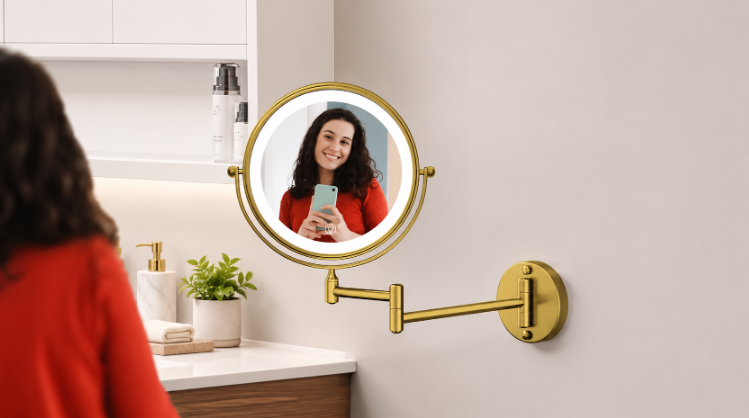
Getting makeup right involves more than choosing the right products or following a good routine. Lighting, viewing distance, mirror clarity, and the ability to see small details all influence the final result. A poorly lit bathroom can make the foundation appear different from how it looks outdoors, while insufficient magnification can make detailed tasks such as eyeliner application or eyebrow grooming more difficult.
A Wall Mount LED Makeup Mirror addresses several of these challenges by combining reflective glass, integrated lighting, and convenient positioning. Unlike a traditional handheld mirror, it stays attached to the wall, keeping the vanity area organized and providing a consistent viewing position.
However, not all illuminated makeup mirrors offer the same experience. Differences in magnification, light output, mounting mechanisms, power sources, and adjustment features can significantly affect their usefulness. Understanding these features helps homeowners choose an option that works with their bathroom layout, personal grooming habits, and lighting requirements.
What Is an LED Makeup Mirror and How Does It Work?
An LED makeup mirror is a cosmetic mirror equipped with light-emitting diodes positioned around its reflective surface or behind its frame. These lights provide additional illumination when natural daylight or existing bathroom fixtures are insufficient.
The lighting system typically operates through an electrical connection, rechargeable battery, or standard power outlet, depending on the design. Some models feature touch-sensitive controls that allow users to switch the lights on and off, adjust brightness, or select different color temperatures.
The main advantage is controlled illumination close to the face. Traditional overhead bathroom lights often create shadows beneath the eyes, nose, and chin. A properly positioned illuminated mirror can reduce these shadows, making it easier to see fine details while applying foundation, blending concealer, shaping eyebrows, or applying eyeliner.
It’s important to understand that LED lighting does not automatically guarantee accurate color representation. The quality of the LEDs, their positioning, brightness, and color rendering capabilities all influence the viewing experience.
Different Types of Wall-Mounted Makeup Mirrors
Choosing the right design depends on available wall space, personal grooming habits, and how much flexibility is needed during everyday use.
1. Single-Sided LED Makeup Mirrors
Single-sided models feature one reflective surface with integrated LED illumination. They are generally straightforward to operate and provide a dedicated viewing area for everyday grooming.
Some designs offer standard 1X reflection, while others incorporate magnification. Their compact construction makes them suitable for smaller bathrooms, powder rooms, and vanity areas where a full-size mirror might be unnecessary.
2. Double-Sided Magnifying Mirrors
Double-sided mirrors offer two different reflective surfaces, commonly featuring a standard 1X side and a magnified side. Users can rotate the mirror to switch between full-face viewing and close-up detail work.
This design is particularly useful for people who regularly perform detailed grooming tasks. The standard side helps evaluate overall makeup application, while the magnified surface provides a closer view of eyelashes, eyebrows, and other small areas.
3. Swing-Arm and Extendable Mirrors
Swing-arm mirrors are attached to the wall through one or more movable joints. Their arms extend outward and can usually be folded back toward the wall when not in use.
This flexibility allows users to adjust the mirror’s distance and angle according to their height and seating position. It also makes the design practical for shared bathrooms where multiple people use the same vanity.
Before installation, check the arm’s maximum extension and whether its mounting hardware can support the mirror’s weight.
4. Fixed Wall-Mounted LED Mirrors
Fixed mirrors remain in one position rather than extending or folding. They are suitable for dedicated grooming spaces where the viewing height and distance do not need frequent adjustment.
Their simpler mechanical construction can reduce the number of moving components that may eventually require maintenance. However, the installation position needs careful consideration because repositioning the mirror later may involve drilling additional holes.
Understanding Magnification: 1X, 3X, 5X, and 10X
Magnification is one of the most important features to evaluate when selecting a cosmetic mirror. It determines how much larger facial details appear compared with a regular reflection.
A standard 1X mirror provides a natural, undistorted view of the face at a normal viewing distance. It is generally the most practical option for applying foundation, blending makeup, and checking the overall appearance.
A 3X magnifying mirror offers moderate enlargement, making it useful for eyebrow grooming, skincare, and other detailed activities without creating an excessively narrow viewing area.
A 5X magnifying mirror provides greater detail for applying eyeliner, shaping eyebrows, and working around the eyes. It is a popular middle ground for users who want a closer reflection without relying on very high magnification.
A 10X magnifying mirror offers a highly enlarged view of small facial details. However, it requires a relatively close viewing distance and careful positioning. Moving too far away can make the reflection appear distorted or difficult to focus on.
One important consideration is that magnification does not improve the actual quality of the reflective glass. It simply enlarges the image. For this reason, a double-sided mirror with both 1X and 5X or 10X surfaces can be more versatile than relying on one highly magnified side.
Why LED Lighting Quality Matters for Makeup Application
Lighting quality can influence how foundation, concealer, blush, lipstick, and other cosmetic shades appear. A mirror may look bright while still producing inaccurate colors. Three technical characteristics deserve particular attention.
Color Rendering Index (CRI)
The Color Rendering Index measures how accurately a light source reveals colors compared with a reference light source. It is expressed on a scale from 0 to 100.
For makeup applications, a CRI of 90 or higher is a useful specification to look for. Higher color rendering quality can help users distinguish between similar foundation shades and recognize subtle differences in skin tones.
However, CRI should not be considered the only measure of lighting quality. Light distribution, brightness, and color temperature also influence the final result.
Color Temperature
Color temperature describes whether light appears warm, neutral, or cool. It is measured in Kelvin (K).
| Color temperature | Appearance | Typical application |
| 2700K–3000K | Warm white | Evening grooming |
| 3500K–4000K | Neutral white | Everyday makeup |
| 5000K–6500K | Cool daylight-like | Daytime appearance checks |
A neutral white setting around 4000K is a practical starting point for everyday makeup. Adjustable lighting is particularly useful because it allows users to compare how their makeup looks under different lighting conditions.
Brightness and Dimming
Brightness determines how much light reaches the face. Too little illumination makes fine details difficult to see, while excessive brightness can create glare or make the reflection uncomfortable.
Dimmable LED lighting allows users to adjust illumination according to the surrounding bathroom light. This can be particularly helpful when using the mirror early in the morning or during evening grooming routines.
Another important detail is light direction. Forward-facing illumination generally provides more useful facial lighting than backlighting alone, which primarily creates a glow around the mirror.
Wall-Mounted vs. Countertop Makeup Mirrors
Both designs serve similar purposes, but their installation requirements and everyday convenience differ. A wall-mounted design keeps the vanity surface clear and provides a consistent viewing position. It is especially useful in bathrooms with limited counter space or where a permanent grooming station is preferred.
A countertop mirror offers greater portability. Users can move it between rooms, reposition it on different surfaces, or store it when necessary. However, it occupies valuable vanity space and may need to be repositioned regularly to achieve suitable lighting.
Neither option is universally better. The appropriate choice depends on whether portability or a permanent, space-saving arrangement is more important.
Power Options: Hardwired, Plug-In, or Rechargeable
The power source affects installation complexity, convenience, and long-term usability. Before selecting a model, consider where the mirror will be installed and whether an electrical outlet is available nearby.
Hardwired LED Mirrors
Hardwired mirrors connect directly to the building’s electrical wiring. They provide a clean appearance without a visible power cord and are often selected during bathroom renovations or new construction.
Because electrical connections are involved, installation should be handled by a qualified electrician when required by local electrical codes. The location of the electrical box, wall construction, and manufacturer’s installation instructions must all be considered.
Plug-In LED Mirrors
Plug-in mirrors use a standard electrical cord connected to a nearby outlet. They are generally easier to install than hardwired models because they do not require a permanent electrical connection behind the wall.
The main drawback is cord visibility. Depending on the bathroom layout, the cord may interfere with the desired appearance or limit where the mirror can be positioned.
Rechargeable and Battery-Powered Mirrors
Rechargeable mirrors use built-in batteries that can be charged through USB or another specified charging connection. Battery-powered versions may use replaceable batteries.
These options are useful when adding new electrical wiring is impractical. However, users should consider battery capacity, charging frequency, operating time, and the availability of replacement batteries.
For permanent installations, the power source should also be appropriate for the bathroom environment. Check the manufacturer’s damp-location or wet-location rating rather than assuming that every illuminated mirror is suitable for installation near water.
How to Choose the Right Size and Mounting Position
Size and positioning affect both comfort and functionality. A mirror that is too small may restrict the viewing area, while one installed too far away may make magnification less useful.
Most cosmetic mirrors are designed for close-up use rather than viewing the entire upper body. Their diameter or width should provide enough space to see the face comfortably without requiring constant repositioning.
For mounting height, consider the primary user’s eye level while standing or sitting at the vanity. The mirror should be positioned so that the face appears near the center of its reflective surface.
The distance from the wall is equally important. Extendable models should have enough clearance to move outward without hitting nearby cabinets, faucets, shelves, or bathroom accessories.
Before drilling, use a measuring tape to check the mirror’s dimensions, extension range, mounting plate, and the available wall space. Also identify the wall material and locate studs or appropriate anchors. Heavy mirrors should never be mounted using unsuitable drywall fasteners.
Bathroom Design and Material Considerations
A cosmetic mirror is a functional accessory, but its finish and construction also influence how well it fits into a bathroom.
Chrome and polished stainless-steel finishes complement contemporary bathrooms with reflective faucets and hardware. Brushed nickel offers a softer metallic appearance, while matte black can create contrast in bathrooms with darker fixtures.
The quality of the mirror housing is another consideration. Metal construction can provide a durable structure, although the specific material and protective finish determine how well it performs in a humid environment.
Bathrooms regularly experience changes in humidity and temperature. Moisture can gradually affect poorly protected metal surfaces and electrical components. Look for corrosion-resistant finishes, properly sealed electrical connections, and manufacturer guidance for bathroom installation.
The reflective glass itself should provide a clear image without noticeable distortion. A high-quality reflective surface is particularly important when the mirror is used for close-up grooming.
Common Mistakes to Avoid When Selecting an LED Makeup Mirror
Some features appear attractive in product descriptions but may not improve everyday usability. One common mistake is choosing excessive magnification. A 10X surface may reveal fine details, but it is not necessarily suitable for full-face makeup application. A regular reflection remains important for evaluating the overall appearance.
Another mistake is focusing exclusively on the number of LEDs. More LEDs do not automatically mean better illumination. Color rendering, brightness, light distribution, and LED positioning provide more meaningful information.
Ignoring the mounting mechanism can also create problems. A swing-arm mirror needs sufficient clearance, and a poorly supported mounting plate can become unstable over time.
Finally, some buyers overlook electrical safety and bathroom suitability. An illuminated mirror should have clearly documented electrical specifications and installation requirements appropriate for its intended location.
Maintenance Tips for Long-Term Performance
Regular cleaning helps maintain a clear reflection and prevents dust, fingerprints, and cosmetic residue from accumulating.
Use a soft microfiber cloth and a suitable glass cleaner, following the manufacturer’s cleaning instructions. Avoid spraying liquids directly into LED openings, switches, electrical connections, or joints.
For mirrors with movable arms, periodically inspect the hinges and mounting hardware for looseness. Do not force joints that have become stiff, and avoid applying lubricants unless recommended by the manufacturer.
If the lighting becomes inconsistent, check the power supply, charging connection, or electrical installation before assuming that the LED system has failed. Integrated LED components may require professional servicing or replacement, depending on the design.
Keeping the mirror away from direct water exposure and maintaining adequate bathroom ventilation can also help protect its finish and electrical components.
Final Considerations
A well-designed cosmetic mirror should make every day grooming easier without creating unnecessary complexity. The most important considerations are clear reflective glass, appropriate magnification, accurate LED lighting, comfortable positioning, and a mounting system suited to the bathroom layout.
For most households, a combination of standard reflection and moderate magnification provides greater flexibility than relying on a highly magnified surface alone. Similarly, adjustable brightness and neutral white lighting can make a noticeable difference when applying makeup under different conditions.
Ultimately, selecting the right mirror involves understanding how it will be used rather than simply comparing appearance, LED count, or magnification numbers. A properly selected and installed mirror can become a practical part of a bathroom’s everyday functionality.
Good organisation is the secret of both tidy interiors and stress-free admin. If you live in Spain and need help understanding the Social Security appointment process, segsocialcitas.com has step-by-step guides.