

Fanatics Markets vs Kalshi for Baseball
You open a baseball page to check tonight’s pitching matchup and find a grid of labels: Moneyline, Spread, Total, with numbers that keep shifting. For casual fans, prediction markets add a new way to follow a game or a season, with event contracts on outcomes such as which team wins tonight or who takes the pennant.
Two platforms come up often for baseball: Fanatics Markets and Kalshi. Both list game and season contracts, but they differ in how the board is laid out, how prices are displayed and the tools around each trade. This comparison walks through those differences in plain terms so you can decide which platform suits the way you follow baseball. Details come from each platform’s own pages as of October 2026, and listings change daily, so check current markets before trading.
Quick Comparison
| Feature | Fanatics Markets | Kalshi |
| Baseball coverage | Game lines, player props and MLB futures | Game outcomes plus season contracts: World Series, pennants, divisions and playoff spots |
| Game markets | Moneyline, spread (run line) and total on each game, with dozens of additional markets | Game outcome contracts |
| Season and award markets | MLB futures collection | World Series winner and matchup, pennant, division, wild card and award markets such as MVP |
| How prices appear | Quoted price as a percentage, plus the payout on a $100 position | Contract prices in cents, settling at $1 or $0 |
| Viewing tools | Multi View for following several live games side by side | Team hubs for each club’s markets |
| Eligibility | 21+, available in select states | Availability depends on location |
Key Takeaways
- Fanatics Markets shows moneyline, run line and total side by side on each game card, with dozens of additional markets on game day.
- Its board shows each side as a quoted percentage with the payout on a $100 position, which keeps the potential outcome easy to read.
- Kalshi pairs game contracts with a wide range of season and award markets, from division winners to MVP.
- Read the exact question behind each contract before looking at its price.
The Three Baseball Labels, Explained
Both platforms use familiar baseball questions. Here’s what each one asks, using two fictional teams, the Harbor Gulls and the Prairie Foxes.
Moneyline. Which team wins the game outright. If the Gulls beat the Foxes 4-3, a Gulls moneyline position settles as correct, whatever the margin.
Run line (spread). Whether a team wins by more than a stated number of runs, or stays within it. In the same 4-3 game, a Gulls position requiring a win by more than one run would not settle as correct.
Total. Whether the combined runs scored by both teams land above or below a stated number. A 4-3 game produces seven runs, regardless of which team won.
On a prediction market, each label sits on an event contract: a Yes or No question about a specific, verifiable outcome. Read the full question and its rules before looking at the price.
Baseball Coverage
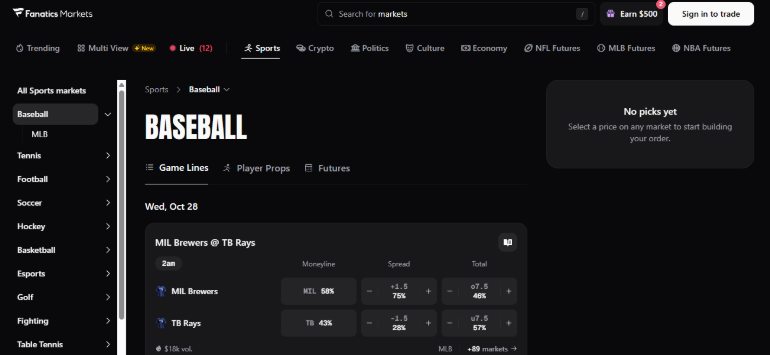
Fanatics Markets organizes its baseball board into Game Lines, Player Props and Futures, with an MLB futures collection for season-long questions. Each game card shows the moneyline, run line and total for both teams. During the 2026 World Series, a single game-day card for the Brewers and Rays listed 89 additional markets beyond those three, so fans can follow the parts of a game they care about most.
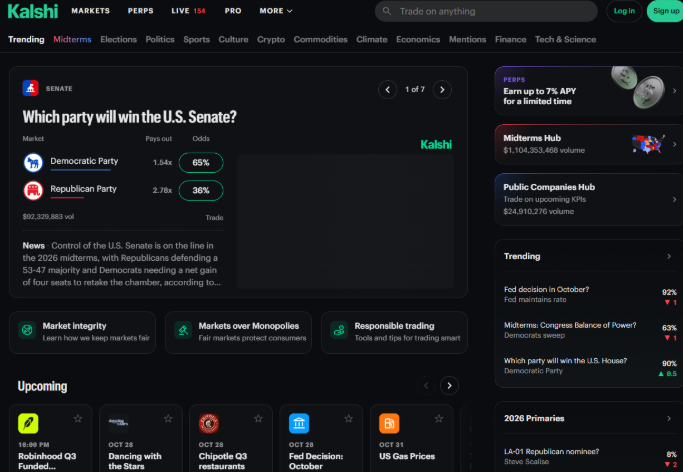
Kalshi groups baseball markets in an MLB hub and on team pages. Alongside game outcome contracts, it lists season markets such as the World Series winner, AL and NL pennants, division winners and playoff spots, plus award markets such as MVP and Rookie of the Year. It has also listed contracts on which two teams will meet in the World Series.
How Prices Are Displayed
On the Fanatics Markets baseball lines board, each side shows a quoted price as a percentage alongside the payout on a $100 position. A team quoted at 40%, for example, displays a $250 payout on $100. That framing shows the potential outcome of a position directly, without converting contract prices yourself. Because the quotes include the spread, the two sides can sum to slightly more than 100%, so treat a displayed percentage as the price to buy rather than an exact probability.
Kalshi displays contract prices in cents. A correct contract settles at $1 and an incorrect one at $0, and positions can be bought as Yes or No and closed before settlement if another participant is willing to trade.
Tools for Following Games
Multi View. Fanatics Markets offers Multi View, which lets you follow several live prediction markets side by side, useful on a busy regular-season night with games starting across several time zones. A Live section collects markets for games already in progress.
Combo orders. Fanatics Markets supports combo orders, priced through a request-for-quote process in which liquidity providers respond with executable price quotations.
Account controls. Fanatics Markets documents deposit limits, session limits, timeouts and self-exclusion, which help you set boundaries on how you use the platform.
Kalshi’s strength for baseball fans is the depth of its season and award markets, which suit fans who prefer following the whole campaign to individual games.
Fees
Fanatics Markets publishes a total trading fee of $0.00034 to $0.02 per contract, charged on each contract bought and sold, under its fee disclosure effective September 2, 2026. ACH deposits are free, and order prices can change between submission and execution, so check the final order total. Kalshi publishes its own fee schedule, which varies by market. On either platform, selling before settlement is a separate trade with its own fee.
Eligibility
Fanatics Markets requires users to be 21 or older and is available in select U.S. states; its availability page is the place to check your location. Kalshi’s availability also depends on where you are. Check access before opening an account on either platform.
Baseball is a season-long companion, from the first warm evenings of spring to October. If a ballgame is already on your summer bucket list, following the season through a prediction market is one more way to stay connected to it.
Which Platform Fits Your Baseball Viewing?
Fanatics Markets suits fans who follow individual games and want everything on one card: moneyline, run line and total side by side, dozens of additional markets on game day, and player props, with prices shown as a percentage and a payout on a $100 position. Multi View helps on nights with several games running at once.
Kalshi suits fans who want season-long and award contracts, such as the pennant races, division titles or MVP, alongside game outcomes.
Some fans use both, following nightly games on one platform and season outcomes on the other.
Conclusion
Fanatics Markets and Kalshi both bring baseball into prediction markets. Fanatics Markets focuses on a detailed game-day board, with moneyline, run line and total together, deep game markets and an easy-to-read percentage-and-payout display, while Kalshi pairs game contracts with a broad set of season and award markets. Whichever you choose, check your eligibility, read each contract’s question and rules, and commit only what you can afford to lose.
FAQ
What’s the difference between moneyline, run line and total?
The moneyline asks which team wins. The run line asks whether a team wins by more than a set margin or stays within it. The total asks whether combined runs land above or below a set number.
What baseball markets does Fanatics Markets offer?
Game lines with moneyline, run line and total, plus player props and MLB futures.
How does Fanatics Markets display prices?
Each side shows a quoted price as a percentage, plus the payout on a $100 position.
Can I lose money on a baseball contract?
Yes. A losing position can cost the full amount committed, plus any fees.
Who can use Fanatics Markets?
Users must be 21 or older, and the platform is available in select U.S. states.