
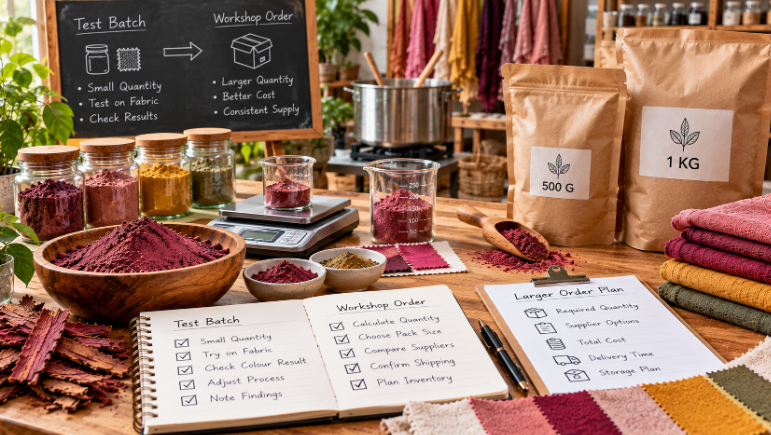
Moving from small Mimosa root bark textile tests to larger workshop orders should be guided by documented consumption and storage capacity. What begins as a series of experimental fabric samples may develop into regular production of handmade scarves, decorative textiles, yarn collections, or botanical craft products.
As production increases, purchasing decisions become more important. Ordering too little material can interrupt scheduled projects, while buying excessive quantities may create storage problems and unnecessary expenses.
For workshops exploring plant-based textile materials, moving from small test batches to larger orders requires particular attention to botanical identification, processing formats, material consumption, and supplier documentation.
A successful transition should be based on actual project records rather than assumptions about how much material a larger workshop might need.
This guide explains how textile makers can evaluate small-batch results, compare botanical material formats, estimate future requirements, and prepare for larger workshop purchases.
Recognizing When a Textile Workshop Is Ready to Scale
Increasing order quantities should be a response to established production requirements, not simply an attempt to secure a lower unit price.
Before purchasing larger packages, workshop owners should review their recent projects and identify patterns in material consumption.
A workshop may be ready to increase its purchasing quantities when:
- Similar textile projects are being produced regularly.
- Material requirements have been documented through previous work.
- The same botanical supplies are repeatedly reordered.
- Suitable storage facilities are available.
- Upcoming production schedules are reasonably predictable.
- Larger purchases fit within the workshop’s operating budget.
These conditions provide a stronger foundation for scaling than relying exclusively on expected future sales.
Separate Experimental Work From Regular Production
Experimental projects often involve unfamiliar materials, changing preparation methods, and uncertain requirements.
Regular production usually benefits from more consistent documentation and established purchasing routines.
Keeping these activities separate can help a workshop avoid purchasing large quantities of materials that have not yet been evaluated.
Documenting Small Test Batches Before Larger Purchases
Small test batches can provide useful information about material handling, preparation requirements, and practical workshop procedures.
However, observations should be recorded systematically.
A simple test record may include:
| Test Record | Information to Document |
| Project Reference | Unique sample or project number |
| Textile Material | Cotton, linen, wool, or another fiber |
| Fabric Weight | Weight of the textile sample |
| Botanical Material | Scientific name and plant part |
| Processing Format | Powder, shredded bark, or chips |
| Material Quantity | Amount used in the test |
| Supplier | Source of the material |
| Batch Information | Lot number, if available |
| Preparation Notes | Relevant project conditions |
| Observations | Documented results without assumptions |
These records help textile makers distinguish repeatable observations from isolated outcomes.
Natural botanical materials may vary between batches, so a successful small-scale experiment does not guarantee identical results during larger production.
Understanding Botanical Material Formats Before Ordering in Bulk
Processing format can affect how a material is handled, measured, stored, and prepared.
Before moving to larger orders, workshop owners should identify which format is appropriate for their established craft procedures.
Fine-Milled Root Bark Powder
Fine powder consists of dried botanical material processed into relatively small particles.
It can be convenient to weigh and divide into portions for controlled craft work.
However, fine particles may become airborne during handling, and some liquid preparations may require careful filtration.
Fine milling does not automatically guarantee stronger dye performance or greater material purity.
Coarse Botanical Powder
Coarse powder contains larger particles and may retain more visible plant texture.
Handling and filtration requirements can differ from those of finely milled materials.
Because suppliers may use different milling standards, buyers should confirm the stated format before purchasing.
Shredded Root Bark
Shredded bark consists of larger dried plant fragments.
It may be useful for botanical demonstrations, educational craft activities, or projects where recognizable plant material is preferred.
Root Bark Chips
Chips are larger pieces of botanical material that may require different preparation and storage arrangements.
The most appropriate format depends on the intended textile application, available equipment, and documented workshop requirements.
Comparing Wholesale Root Bark Material Options
When material consumption becomes predictable, larger packages may be worth evaluating.
For example, workshop owners researching Mimosa hostilis root bark can examine the wholesale page on mimosahostilis.shop as part of their supplier comparison process.
The product listing is intended for buyers considering a 10kg quantity.
Before ordering, confirm the exact botanical material, selected processing format, current price, packaging details, and destination eligibility.
Supplier statements about purity, sustainability, laboratory testing, or product consistency should be treated as seller-provided claims unless appropriate supporting documentation has been independently reviewed.
Questions to Ask Before Purchasing a Large Package
Consider the following:
- Has the material been evaluated for the intended textile project?
- Is the scientific botanical name clearly identified?
- Does the selected format match previous purchases?
- Are batch or sourcing records available?
- Can the workshop store the entire quantity appropriately?
- Are the total purchasing and delivery costs acceptable?
- Does the expected production schedule justify the order?
These questions can help prevent unnecessary bulk purchasing.
Using Medium-Sized Packages as a Transition
Moving directly from small test quantities to a large wholesale order is not always necessary.
A medium-sized package can provide an intermediate purchasing option for workshops that are still establishing their regular material requirements.
For example, textile makers comparing smaller quantities may review a 500g MHRB powder listing when evaluating package sizes and material formats.
Before purchasing, buyers should verify the specific product variation, current price, and published ordering conditions.
A 500g package may be easier to manage than a larger order when material consumption remains uncertain.
However, package weight alone does not determine whether a material is suitable for a particular textile application.
Why Intermediate Orders Can Be Useful
Medium-sized orders may help workshops:
- Avoid committing to excessive inventory.
- Review packaging and labeling practices.
- Maintain more manageable storage quantities.
- Track material consumption across several projects.
- Refine future purchasing forecasts.
This approach allows purchasing decisions to develop alongside documented workshop requirements.
Estimating Material Needs for Larger Textile Projects
Scaling production begins with understanding how much textile material will be processed.
Suppose a studio currently produces 20 handmade scarves each month.
Each scarf weighs approximately 160 grams.
The total monthly fabric weight would be:
20 × 160g = 3,200g
This equals 3.2kg of fabric.
If the workshop plans to increase production to 75 scarves, the projected fabric weight becomes:
75 × 160g = 12,000g
This equals 12kg of fabric.
The increase provides a useful measure of production growth.
However, fabric weight alone does not establish how much botanical powder or bark will be required.
Use Actual Material Consumption Records
Natural botanical ingredients can vary in composition depending on species, origin, processing, and storage conditions.
Different textile fibers and preparation methods may also influence results.
For this reason, workshops should use documented small-scale testing to estimate material requirements rather than assuming a universal botanical-to-fabric ratio.
Calculating the Financial Value of Larger Orders
Bulk purchasing may reduce the cost per kilogram, but the lowest unit price does not always represent the best overall purchasing decision.
The basic calculation is:
Cost per kilogram = Total package price ÷ Package weight in kilograms
Consider the following hypothetical comparison:
| Package Weight | Illustrative Price | Cost per Kilogram |
| 250g | $35 | $140 |
| 500g | $65 | $130 |
| 1kg | $120 | $120 |
| 5kg | $550 | $110 |
| 10kg | $1,000 | $100 |
These figures are hypothetical examples and do not represent verified supplier prices.
The example illustrates how unit costs may decrease as package size increases.
However, workshops should also account for shipping charges, taxes, storage requirements, and the possibility of unused inventory.
Consider Cash Flow Before Buying in Bulk
Large purchases can reduce the funds available for fabric, packaging, equipment maintenance, and other operating expenses.
A practical purchasing strategy should support the entire workshop rather than focus only on one material category.
Establishing a Reliable Workshop Reorder Schedule
As production grows, relying on last-minute purchasing becomes increasingly risky.
A basic reorder system can help workshops maintain suitable inventory levels.
Track Average Consumption
Record how much of each material is used during completed projects.
Estimate Supplier Lead Times
Use confirmed supplier information and previous delivery records to estimate how long replacement orders may take.
Establish a Reorder Point
A common inventory planning formula is:
Reorder point = Expected material use during supplier lead time + Safety stock
Safety stock should reflect realistic demand variation, available storage, and the consequences of a delivery delay.
Review Inventory Regularly
Material consumption may change as the workshop expands.
Update purchasing quantities based on actual records rather than outdated estimates.
Checking Shipping Policies Before Placing Larger Orders
Shipping conditions become more important as package weight and order value increase.
A supplier may advertise particular delivery benefits, but eligibility can depend on the destination, selected product, and current purchasing policies.
Before finalizing an order, verify:
- Supported delivery destinations.
- Shipping and handling charges.
- Estimated processing times.
- Tracking availability.
- Packaging arrangements.
- Return and replacement procedures.
- Customs or import restrictions.
- Applicable local regulations.
Published delivery estimates should not be treated as guaranteed arrival dates.
International buyers should confirm whether the selected botanical material is permitted at the destination before purchasing.
Preparing Storage Space for Increased Inventory
Larger orders require suitable storage arrangements.
Botanical materials should be kept in appropriate containers and protected from excessive moisture, contamination, and unsuitable environmental conditions.
Clearly label each container with the botanical name, processing format, purchase date, and batch number when available.
Fine powders can create airborne dust, so appropriate ventilation and protective equipment may be necessary.
Keep botanical craft supplies separate from food preparation areas.
If textile projects involve mordants or other processing chemicals, follow the relevant safety instructions and disposal requirements.
Natural origin does not automatically mean a material is harmless.
Common Mistakes When Moving to Larger Workshop Orders
Purchasing Bulk Materials Before Establishing Demand
Large orders can create unnecessary inventory when production requirements remain uncertain.
Treating All Botanical Formats as Identical
Powdered, shredded, and chipped materials may require different handling procedures.
Ignoring Supplier Documentation
Incomplete botanical identification or missing batch records can complicate repeat purchasing.
Overlooking Storage and Shipping Costs
A lower unit price may be offset by additional delivery and storage expenses.
Expecting Identical Dye Results at Larger Scale
Natural materials and textile preparation conditions can vary.
Specific dye shades, color intensity, and colorfastness should not be assumed without appropriate testing.
Frequently Asked Questions About Scaling Botanical Craft Orders
When should a textile workshop consider buying botanical materials in bulk?
Bulk purchasing may be appropriate when material requirements are established, production demand is predictable, and suitable storage is available.
Is a 500g package useful before placing a larger order?
A medium-sized package can provide a manageable purchasing option while a workshop continues documenting material consumption.
What is the difference between root bark powder and shredded bark?
Powder contains smaller particles, while shredded bark consists of larger plant fragments. Their handling and preparation requirements may differ.
How can I estimate botanical material requirements for larger textile projects?
Review previous test records, calculate projected fabric quantities, and use documented material consumption to develop realistic estimates.
Does purchasing larger quantities always reduce overall costs?
Not necessarily. Shipping, taxes, storage, and unused inventory can affect the total financial value of a bulk order.
What should I verify before ordering botanical materials internationally?
Confirm product identification, processing format, shipping eligibility, customs requirements, applicable regulations, and total purchasing costs.
Conclusion: Scale Workshop Purchasing With Reliable Records
Moving from small test batches to larger workshop orders is an important step for textile makers developing more consistent production routines.
A successful transition depends on understanding botanical material formats, maintaining accurate project records, and selecting package sizes that match actual demand.
Smaller quantities can support initial testing, medium-sized packages may provide flexibility during the transition, and larger orders can become practical when material requirements are predictable.
By comparing supplier information, reviewing delivery conditions, organizing inventory, and avoiding unsupported assumptions about dye performance, textile workshops can make better purchasing decisions.
Careful planning allows production to expand while keeping material costs, storage requirements, and purchasing risks under control.