
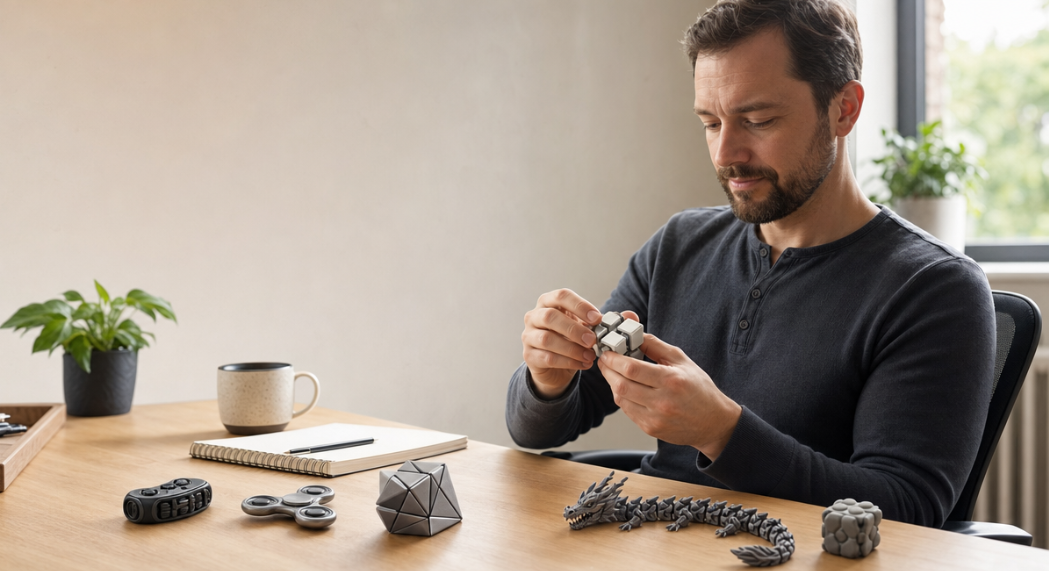
Anxiety can make even ordinary situations feel uncomfortable. Maybe your hands feel restless during a meeting, you keep tapping your foot while studying, or you reach for your phone whenever you have to wait. For some people, 3D printed fidget toys can provide a simple, hands-on activity during those moments.
Fidget toys are not designed to make anxiety disappear. Instead, they can give your hands something predictable to do and provide tactile feedback when you feel tense or restless. The right option depends on the type of movement or sensation you find most comfortable.
So, which types are worth trying, and how do you choose one that actually fits your needs?
How Can Fidget Toys Help With Anxiety?
Fidget toys give you something physical to focus on when you feel restless. Repetitive actions such as clicking, squeezing, spinning, or bending can provide a predictable sensory experience.
That doesn’t mean every fidget works for every person. Some people find repetitive movement relaxing, while others prefer stronger resistance or more varied movement.
Think of a fidget as one small tool that may make certain moments easier to handle—not as a treatment for anxiety.
Types of Fidget Toys for Anxiety
Different designs create different physical experiences. Finding the right one often comes down to what your hands naturally enjoy doing.
Clicker Fidgets
Clickers are probably the simplest option. Press one section, feel the mechanism respond, and repeat.
They work well if you enjoy repetitive finger movements and want something easy to use while reading, working, or waiting. A compact clicker can also be convenient when you don’t want to draw attention to yourself.
Spinner Fidgets
Spinners offer a smooth, continuous motion rather than a repeated click.
They can be a good choice if you like predictable movement but don’t want to constantly press something. Because they require relatively little attention, they can also fit naturally into activities such as studying or listening.
Squeeze Fidgets
Squeeze toys provide more noticeable resistance.
You can press and release them repeatedly, making them a practical choice if you prefer using your whole hand rather than just your fingers. The physical resistance can also make the interaction feel more substantial than a lightweight spinner.
Geometric and Mechanical Fidgets
These designs usually give you more than one way to interact with them. You may rotate, shift, or manipulate different sections instead of repeating exactly the same movement.
They are a good fit for people who enjoy mechanical feedback and want a fidget that keeps their hands slightly more engaged.
Articulated Fidgets
Articulated fidgets use connected sections that bend, twist, and change position.
They can feel more playful because the movement changes as you use them. Instead of one repeated action, you can slowly work through the different joints with your fingers.
They can also double as desk or shelf decorations when you’re not using them.
How to Choose a Fidget for Anxiety
You don’t need to find the most popular fidget. Start with the sensation you actually enjoy.
Prefer repetition? A clicker or spinner may feel natural.
Want more resistance? Try a squeeze-style design.
Enjoy changing movements? An articulated or mechanical fidget may be more interesting.
Need something for work or school? Look for a quiet design that won’t draw attention.
The best fidget is usually the one you can use almost without thinking. If you have to concentrate on operating it, it may not be doing what you want.
3D Printed Fidget Toys for Anxiety
3D printing gives fidget designs more freedom. Instead of sticking to standard shapes, designers can create unusual geometry, moving structures, and playful objects that feel different in the hand.
Nexbie’s fidget toys includes clickers, geometric fidgets, and articulated designs. A clicker provides a short, firm press-and-release motion, while an articulated design gives your fingers a series of connected movements to explore.
That variety can be useful when you’re trying to figure out what type of movement feels most satisfying. It also means a fidget can be something you genuinely enjoy keeping on your desk, rather than something that looks purely functional.
Frequently Asked Questions
What type of fidget is best for anxiety?
There isn’t one best option for everyone. Simple clickers, spinners, squeeze toys, and articulated fidgets can all work differently. Start with the movement or resistance that feels most comfortable to you.
Are quiet fidget toys better for anxiety?
They can be more practical when you’re around other people. A quiet design is less likely to create another source of distraction in places such as offices, classrooms, or libraries.
Can adults use fidget toys for anxiety?
Yes. Fidget toys for adults can fit naturally into work, study, travel, or everyday breaks. Compact designs are particularly convenient for desks and shared spaces.
Are fidget toys suitable for children with anxiety?
They may be useful for some children, but the product should match the child’s age and abilities. Parents should follow age recommendations and check the design for small or detachable parts.
How do I know if a fidget is helping?
Pay attention to what happens while you use it. If you feel more comfortable and can stay engaged with what you’re doing, it may be useful. If it becomes the main distraction, try a simpler design.
Conclusion
Choosing fidget toys for anxiety doesn’t have to be complicated. The right option is usually the one that provides a comfortable movement or sensation without demanding too much of your attention.
Clickers and spinners are useful for simple, repetitive movement, while squeeze, mechanical, and articulated designs offer different kinds of tactile feedback. Where you plan to use the toy matters just as much as how it feels.
Whether you choose a quiet fidget for work or a more playful 3D printed design for home, start with what feels natural in your hand. A small, satisfying movement may be all you need to make a stressful moment feel a little easier.