
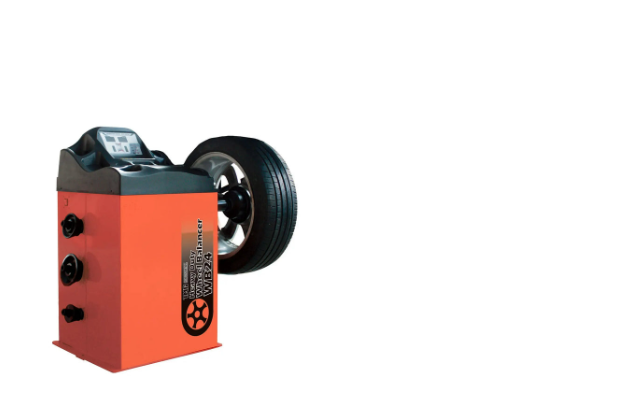
Every shop meets the wheel that will not settle down
It happens a few times a season in any American shop. A wheel balancer reports a correction, the technician applies it, the wheel spins again, and the machine asks for weight in a different place. The instinct is to blame the equipment, and it is almost never the equipment.
Balancing corrects an uneven distribution of mass. It does nothing about an assembly that is not round, nothing about how that assembly is held, and nothing about the three or four other rotating parts under the vehicle. Once those boundaries are clear, the diagnosis stops being guesswork.
A round wheel and a balanced wheel are different claims
Radial runout describes how much the rolling radius varies as the assembly turns. A tire can be perfectly balanced and still rise and fall a fraction of an inch each revolution, which the driver feels as a rhythmic thump that no amount of lead will remove.
Lateral runout is the sideways version, the wheel wobbling as it spins. A wheel balancer measures mass, not shape, so it reports these assemblies as acceptable while the vehicle continues to shake, which is why a runout gauge belongs beside the machine rather than in a drawer.
The speed a vibration appears at narrows the search considerably
A tire turns roughly fifteen times a second at highway speed, and an imbalance in it produces a shake that begins somewhere around fifty miles an hour, peaks, and often softens again as the car goes faster. That pattern is characteristic and worth recognizing before anything is dismounted.
A driveshaft turns three or four times faster than the wheels, so its vibrations arrive at lower road speeds and grow steadily rather than peaking. Anything changing with engine speed while the car coasts is not a wheel problem at all.
Rims bend more easily than owners expect
A hard pothole strike deforms an alloy rim without leaving a mark anyone notices. The damage often shows up on the inner flange facing the vehicle, hidden behind the brake, and it produces exactly the symptoms of imbalance, which is why a wheel balancer keeps calling for weight that settles nothing.
Checking for it costs a minute. With the assembly still on the machine, a dial gauge held against the bead seat while the wheel is turned by hand shows a bent rim immediately, and it distinguishes a wheel worth straightening from a tire that simply needs replacing.
Some tires pull the car without being unbalanced at all
Conicity is a manufacturing variation that leaves a tire slightly cone shaped, so it rolls toward one side the way a paper cup does. It causes a steady pull rather than a shake, it survives every attempt a wheel balancer makes to correct it, and swapping the tire side to side confirms it in minutes.
If the pull follows the tire to the other side of the car, the tire is the cause. If it stays where it was, the vehicle needs an alignment instead. That single test separates two complaints that arrive at the counter described in identical language.
How the wheel sits on the machine is its own source of error
The assembly has to spin on the machine exactly as it spins on the vehicle, and that is not automatic. A cone pushed through the center bore centers the wheel on that bore, which is right for hub centric wheels and wrong for aftermarket wheels located by their studs.
The consequence is a correction that is accurate on the machine and useless on the car. Fitting a flange plate that locates the wheel by its stud holes reproduces the real mounting, and it explains a fair number of assemblies that read perfect on a wheel balancer and shake on the road.
Weights come off for reasons unrelated to balance
Adhesive weights need a clean, dry, room temperature surface to hold. Applied over brake dust, road film, or a cold rim in February, they let go within weeks, and the customer returns convinced the wheel went out of balance on its own.
Corrosion does the same thing more slowly, with salt working under the adhesive from the edge until the weight lets go on the highway. Wiping the inner barrel with solvent first is the step most often skipped and most often responsible.
Match mounting cancels one error against another
Both tire and rim have a high point, neither of which a wheel balancer can see, and mounting them at random can stack those two errors on top of each other. Rotating the tire on the rim so its high point meets the low point of the wheel reduces the combined runout, often turning a failing assembly into a good one.
Manufacturers mark the reference point on new tires, usually as a colored dot, and aligning that with the valve stem is the fast version of the same idea. On an assembly already built the marks are gone, so the high points get found with a gauge.
Road force testing measures what a balancer cannot
The most complete answer presses a loaded roller against the tire while it turns, reproducing the vehicle’s weight and measuring how the force varies through one revolution. That catches a stiff spot in the sidewall, which is neither imbalance nor runout but still shakes the car.
Vibrations divide by what the machine can see
- Mass imbalance: correctable with weight
- Runout: a shape problem, weight will not fix
- Conicity: a pull, not a shake
- Driveline: appears at the wrong road speed
A few habits around a wheel spinning at highway speed
The hood comes down before the spin starts, nobody stands in the plane of the wheel, and the assembly is checked for a loose weight first. A wheel balancer with self diagnosis also flags its own calibration drift, because a machine reporting confidently is not necessarily reporting correctly.
Where a balancer answers the question and where it cannot
- Strength: finds mass errors in one spin
- Strength: rules out the easy cause first
- Limit: blind to a rim that is not round
- Limit: cannot detect a coned tire
Weighed against replacing parts until the shaking stops, ten extra minutes with a gauge costs almost nothing and prevents a customer returning twice. A shop in Ohio checks runout on any assembly needing more than two ounces, and that rule ended most of its comeback work.
Diagnosis is moving upstream of the correction
Tire shops increasingly measure the assembly before deciding what to do with it, treating balancing as one step in a sequence rather than as the answer to every complaint of vibration that arrives at the counter.
That sequence is why the automotive equipment TMG Industrial supplies reports its own condition through self diagnosis, so a technician knows the reading can be trusted before looking anywhere else.