
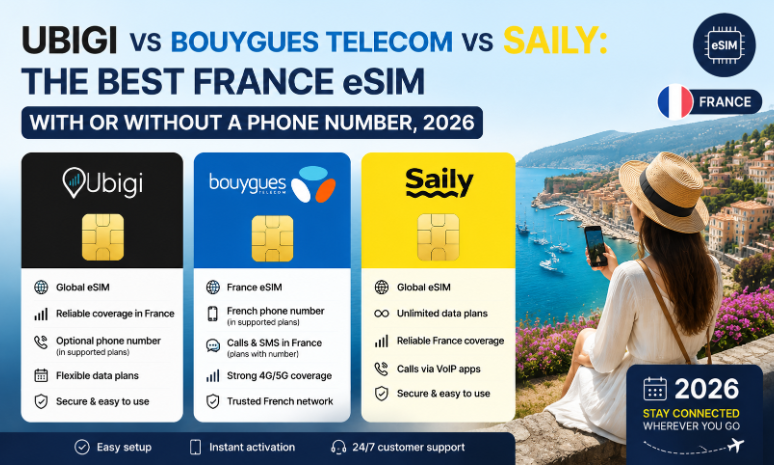
TL;DR
- Best for multi-device data sharing: Ubigi – a reusable eSIM on Free Mobile and Orange, shared across phones, tablets, and Windows laptops, plus a 12-month France plan
- Best for France’s own carrier network: Bouygues Telecom – a prepaid line on one of France’s four national operators, running on its own 4G and 5G, with a French +33 number and calls and SMS across Europe
- Best for data coverage: Saily – 200+ destinations, France plans from US$3.99, an unlimited data plan on Saily Ultra, an optional Saily phone number, activation on arrival, unlimited hotspot, in-app top-up, 24/7 live chat, and security tools no rival ships
- Criteria: French network coverage, data versus calls and SMS, tethering, France versus France plus Europe, and what “unlimited” really means.
Why the France eSIM Choice Is Harder Than It Looks
Most travelers pick a France eSIM based on price per gigabyte alone. That works right up until a Paris hotel needs to reach you about a late check-in, or a booking system demands an SMS code, and your plan receives neither.
France runs strong mobile infrastructure, so the network is rarely the problem. Arcep, the French telecoms regulator, reports 4G now underpins all mobile service effectively nationwide [1]. EU residents also get “Roam like at home” protection through 2032, while anyone arriving from outside the bloc gets none of it [3].
The eSIM you buy decides the outcome, and only one of these three carries a native French number.
Before you read on: none of these links are affiliate links, and we earn no commission from any of the services here. Everything reflects our own unbiased research.
Understanding the Biggest Difference: Data Plans vs a Line With Calls and SMS
What Does a Data eSIM Actually Do?
A data eSIM gives you mobile internet, and that is what most travelers open on their phone. Ubigi works as pure data, as do most travel eSIMs, while Saily is a data eSIM that also offers an optional phone number for calls and texts. Either way, mobile data covers almost everything you actually use:
- Internet access on 4G and 5G, from Paris to a village in the Dordogne
- WhatsApp calls and messages, which is how most of Europe reaches you anyway
- FaceTime audio and video over data
- Google Maps navigation, roughly 10 MB per hour on Saily’s published figures
- Uber, Bolt, and other ride-hailing
- Banking apps, including contactless setup
- Email and calendar sync
When Do You Actually Need a French Phone Number?
A French number earns its cost only when something in France needs to dial or text you. You want a +33 line if you are:
- Calling French hotels directly, especially small independents that answer the phone faster
- Making restaurant reservations by phone, still the norm outside the big booking platforms
- Contacting local businesses, from car hire desks to a rural gîte owner
- Receiving SMS, including the verification codes French services send mid-booking
- Using French delivery apps, which often demand an SMS-verifiable local number
- Staying long-term, where a French number is basic admin
You probably do not if you are on:
- A vacation with the itinerary already booked
- A city break in Paris, Lyon, or Nice under two weeks
- A backpacking trip around hostel Wi-Fi
- Remote work, where calls happen on Zoom or Slack
- Travel with WhatsApp, Europe’s default phone book
Your itinerary decides which list you are on. Paying for a French number you never dial is the most common overspend here, and skipping one when a booking flow demands an SMS code is the most common regret.
Provider Profiles: What Makes Each One Different?
| Saily | Ubigi | Bouygues Telecom | |
| Best for | Data coverage | Multi-device data sharing | France’s own carrier network |
| France entry price | US$3.99 (1 GB / 7 days) | US$10 (10 GB / 30 days) | €29.90 (30 GB / 30 days) |
| Phone number | US (+1) option | None | French (+33), included |
| Calls and SMS | Optional voice + SMS add-on | VoIP apps only | Included, Europe-wide |
| Coverage | 200+ destinations | Wide multi-country coverage | France + ~38 European countries |
| Tethering | Unlimited, no restrictions | Allowed, multi-device | Included |
| Security tools | 115+ virtual locations, ad blocker, web protection | None | None |
| Support | 24/7 live chat | Help center and contact form | French retail stores |
Ubigi: Best for Frequent Travelers Who Share Data Across Devices and Stay for Months
Ubigi sells eSIM data through direct carrier relationships rather than as a reseller marketplace, as a brand of Transatel, now part of NTT. That parentage is the story. It is why Ubigi turns up preinstalled in cars and laptops, and why its eSIM behaves less like an app than a carrier line.
Coverage in France runs on Free Mobile and Orange, and the eSIM is reusable across a wide range of destinations. The range rewards people who stay a while: as of July 2026, Ubigi sells 10 GB for 30 days at US$10, a large 30-day data plan at US$39, and an unusual 5 GB per month for 12 months at US$22.
Ubigi permits data sharing outright, which matters more than it sounds. Tether a laptop, a tablet, and a companion’s phone off one plan, then top up in the app without Wi-Fi or remaining data, precisely the moment most eSIM apps fail you.
The app does the job without polish, support runs through a help center rather than live chat, and unactivated plans expire after 6 months.
Strengths:
- Direct carrier infrastructure through Transatel and NTT, with Free Mobile and Orange access in France
- Data sharing across phones, tablets, and Windows laptops from a single plan
- Long-validity options no travel eSIM rival matches, including a 12-month France plan, plus in-app top-ups that work with no Wi-Fi and no data left
Limitations:
- Data-only, with no phone number and no SMS
- No live chat, so mid-trip problems move slower
- Unactivated plans expire after 6 months
Who Should Consider Ubigi: Frequent travelers tethering multiple devices across long stays.
Bouygues Telecom: Best for Buying Direct From France’s Own Carrier Network
Bouygues Telecom operates a national mobile network, not a travel eSIM marketplace. It is one of France’s four operators, alongside Orange, SFR, and Free, and it sells a tourist product called My European eSIM on its own network. You become a customer of a French carrier rather than of a company renting capacity from one, with retail stores across France behind it.
My European eSIM is the only native French line in this comparison. As of July 2026, it costs €29.90 for 30 GB over 30 days, with unlimited calls and SMS within Europe and a French +33 number. Coverage spans France and roughly 38 European countries, tethering is included, and the eSIM recharges across trips.
Bouygues caps its coverage in Europe, and that is the catch. The plan is useless the moment your trip continues to Morocco, and 30 GB is poor value on a four-day break where you use three.
Strengths:
- Runs natively on Bouygues Telecom’s own 4G and 5G network, one of France’s four national operators, with national retail stores behind it
- Prepaid and rechargeable, so the line survives to your next European trip
- Includes a French +33 number that receives calls, SMS, and verification codes
Limitations:
- Europe-only, with no value outside the continent
- €29.90 for a fixed 30 GB is expensive on a short trip
- Sold through third-party resellers as often as directly, which complicates support
Who Should Consider Bouygues Telecom: Students, expats, and long-stay visitors who specifically want to buy direct from a French home-market carrier.
Saily: Best Overall for Most Tourists Who Want Reliable Data, Fair Plan Choices, and Easy Activation
Saily sells country, regional, and global eSIM data plans through an app that also offers security services. It is built by Nord Security, the company behind NordVPN, and it is the travel eSIM that ships online protection (115+ virtual locations, an ad blocker, and malicious-site blocking) inside the same app that sells the data. Neither rival here ships any of it.
Coverage earns it the top spot. Saily runs across 200+ destinations, Saily’s Europe regional plan covers 35 countries from US$4.99, and its global plan reaches 121. One Saily eSIM handles all of them: you add a destination and top up rather than installing a new profile.
France pricing on Saily, as of July 2026, starts at US$3.99 for 1 GB over 7 days, then 3 GB at US$8.99, 10 GB at US$19.99, and Saily’s unlimited data plan at US$48.99. On Saily’s unlimited data plan, your data continues at up to 1 Mbps once the daily high-speed allowance is used, which comfortably handles maps, messaging, music, and email. Hotspot use is unlimited, and plans activate automatically when you land.
Independent reviewers keep singling out that security layer. TechRadar’s 2026 review found no comparable provider bundles an ad blocker, web protection, and virtual location into the base plan without charging extra [2].
https://www.youtube.com/watch?v=ZgjVmKK8Xfk
Strengths:
- Saily’s unlimited data plan on Saily Ultra, for travelers who would rather not count gigabytes
- An optional Saily phone number adds calls and texts to any data plan, which most travel eSIMs cannot do
- Coverage across 200+ destinations with country, regional, and global plans on one reusable Saily eSIM
- Ships 115+ virtual locations, an in-app ad blocker, and malicious-site blocking, features no major competitor offers
- Unlimited hotspot sharing with no restrictions, and plans that activate automatically on arrival
Limitations:
- A local French prepaid SIM still beats Saily on cost per gigabyte on a long single-country stay
Who Should Consider Saily: Travelers who want the widest coverage and easy app management.
Phone Number Comparison: Where the Real Differences Appear
If You Need Calls and SMS
If a French service needs to call or text you, Bouygues Telecom is the only option here with a native French +33 number. That line takes incoming calls, places outgoing calls at local rates, sends and receives SMS, and accepts the verification texts French banks and booking platforms send.
Saily also offers a number, a US (+1) line you add in the app, with no French or European option. It is useful for two-factor codes from US services and for keeping a travel line separate from your personal one. It will not book you a table in the Marais.
Three traveler types get real value from a French number:
- Students abroad, who need a local line for enrollment, housing, and a bank account
- Expats and long-stay visitors, for whom French administration assumes a +33 number
- Business travelers meeting French clients, where a local number reads as local presence
If You Only Need Mobile Data
Most vacation travelers never dial a French number and never receive an SMS from one. Their whole communication stack runs over data, which a US$8.99 Saily plan handles as well as a €29.90 voice plan.
Data alone covers WhatsApp, Messenger, FaceTime, Telegram, Signal, and Google Meet, which is where the people you actually talk to already are. A French number buys a channel your friends do not use.
Your home number also stays alive on your physical SIM. Keep mobile data off on that line, let the eSIM handle internet access, and you can still take calls on the number your bank already has.
Frequently Asked Questions
Can I get a French phone number with a travel eSIM?
Most travel eSIMs do not offer one. Ubigi sells data-only plans, and Saily’s optional number add-on is a US (+1) line rather than a French one. Bouygues Telecom’s My European eSIM is the option here with a genuine French +33 number, calls, and SMS.
Do I keep my own phone number when I use a France eSIM?
Yes. The eSIM sits alongside your physical SIM, so your home number stays active for calls, iMessage, and WhatsApp. Switch mobile data off on your home line and on for the eSIM, and you avoid roaming charges entirely.
Which French network does my eSIM actually run on?
Ubigi’s France plans run on Free Mobile and Orange, Bouygues Telecom runs on its own network, and Saily connects through France’s local carriers. All four French networks now deliver 4G to effectively the whole population, so the practical gap is small [1].
Is Saily’s unlimited plan really unlimited?
Saily’s unlimited data plan is unlimited on volume. You get a high-speed daily allowance, then your data continues at up to 1 Mbps until the daily reset, which comfortably handles maps, messaging, music, and email. It does not carry HD video, so size the high-speed allowance if you plan to stream.
Can I use a France eSIM as a hotspot?
Yes. Saily allows unlimited hotspot sharing, Ubigi permits data sharing across devices, and Bouygues includes tethering. Hotspot support is not the dividing line.
The Bottom Line
The best France eSIM in 2026 comes down to one question, and it is not price. Ask whether anything in France needs to call or text you.
If you tether several devices across a long stay, Ubigi is sharper. If you specifically want to buy direct from a French national carrier, with a native +33 line for the length of your stay, Bouygues Telecom is the only one here that offers it.
For most vacations and city breaks, Saily wins: the widest coverage of the three, France plans from US$3.99, unlimited hotspot use, Saily’s unlimited data plan when you would rather not count gigabytes, and a security layer nobody else ships.
References
[1] Arcep. (2026, March 30). Mobile networks: Arcep publishes a report on the impact that the shutdown of 2G and 3G technologies will have on mobile network coverage. https://en.arcep.fr/news/press-releases/view/n/mobile-networks-300326.html
[2] Singh, P. (2026, May 22). Saily eSIM review 2026: NordVPN’s take on travel data. TechRadar. https://www.techradar.com/pro/saily-review
[3] European Commission. (2022, July 1). New roaming rules for travellers in the EU: “Roam like at home” for 10 more years. Shaping Europe’s Digital Future. https://digital-strategy.ec.europa.eu/en/news/new-roaming-rules-travellers-eu-roam-home-10-more-years