
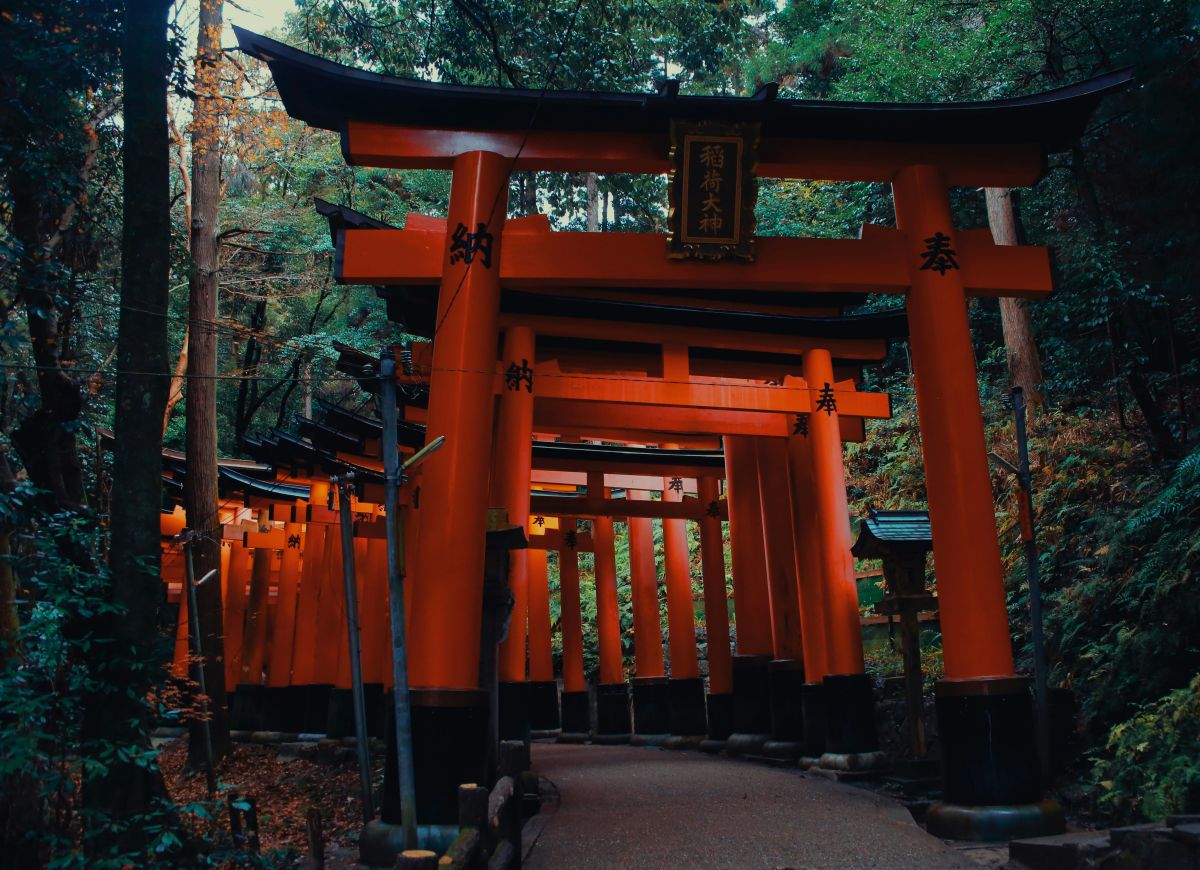
At Fushimi Inari, there is no clear beginning. You arrive, pass beneath the first gate, and then you’re already inside it. Another gate appears. Then another. There’s no sign telling you how far to go or how long to stay.
Walking through Fushimi Inari Taisha doesn’t feel ceremonial. It feels habitual, as though people have been doing this so long that the path no longer needs explanation. The gates repeat. The incline barely registers at first. Sound thins out.
You might expect the repetition to feel staged. It doesn’t. It feels practical. Familiar. Almost ordinary.
Turning Back Feels Complete
Most people don’t walk the entire route. They stop when they feel like stopping. That decision doesn’t feel like giving up. It feels correct.
The gates don’t build toward a reveal. They don’t promise an ending. You walk, you pause, you turn back. The experience doesn’t change much whether you stay ten minutes or an hour.
That lack of escalation is part of the effect. Nothing insists on climax.
Kyoto Doesn’t Signal When Something Matters
Away from the shrine, Kyoto continues in the same understated way. Streets narrow. Buildings lower their voices. You pass something that might be important, but no one points it out.
Kyoto doesn’t reward speed. It also doesn’t punish it. It simply doesn’t respond to it. When you slow down, the city seems to acknowledge you. When you rush, it stays the same.
That indifference feels intentional, even if it isn’t.
Travel That Requires Very Little of You
Moving between cities in Japan rarely feels like a task. You show up. You sit. Things happen as expected. People familiar with high-speed rail elsewhere often liken the ease to booking KTX tickets — the process works so smoothly it fades into the background.
There’s no sense of transition as an event. The journey becomes a neutral space. A pause where nothing is asked of you.
That pause matters more than the distance covered.

Tokyo Doesn’t Wait for Interpretation
Tokyo does not unfold gradually. You step into it and it’s already in progress. Screens glow. Trains pass. People move with purpose.
Despite this, it’s rarely aggressive. You’re not pushed. You’re not rushed. You’re simply absorbed into a system that already knows how to function.
Confusion doesn’t last long. There’s always a rhythm to follow, even if you don’t understand it yet.
Speed Without Sensation
Taking the Tokyo to Kyoto bullet train feels oddly disconnected from speed. Outside the window, the landscape collapses into motion. Inside, almost nothing changes.
People speak quietly. Movements are small. There’s no urgency in the carriage, despite how quickly you’re moving. Time passes without texture.
You arrive without feeling delivered. You’re simply… there.
Standing Still at Shibuya
Near Shibuya Crossing, you notice the pause before the movement. Hundreds of people wait. The lights change. Everyone steps forward.
The crossing fills, then empties. No one lingers. No one hesitates excessively. The moment ends as cleanly as it began.
Watching it doesn’t feel dramatic. It feels routine. That’s what makes it strange.
Noise That Doesn’t Escalate
Shibuya is loud, but the noise doesn’t spiral. Music overlaps. Screens flash. Announcements echo. And yet, nothing tips over.
People queue automatically. Space is negotiated without discussion. You realise that density doesn’t have to mean disorder.
The intensity feels maintained rather than uncontrolled.
Familiar Behaviour in Unfamiliar Places
What links Fushimi Inari and Shibuya is not symbolism. It’s behaviour. In both places, people move with others in mind. Silence appears where it’s needed. Attention shifts without instruction.
At the shrine, that means walking quietly. At the crossing, it means timing your steps. The setting changes, but the logic doesn’t.
Once you notice that, the contrast loses its sharpness.
Ritual Without Ceremony
Ritual in Japan often passes unnoticed. It’s embedded in repetition — waiting, walking, boarding, crossing. No one frames these actions as meaningful. They’re simply done.
Over time, the predictability becomes reassuring. Even in crowded spaces, you’re rarely unsure of what comes next.
That predictability allows intensity to exist without friction.
Remembering Without Trying To
Later, what returns are not explanations. It’s the feel of walking beneath gates that didn’t ask you to hurry. The brief stillness before a pedestrian light changed. The quiet inside a fast train.
These moments don’t announce themselves while they’re happening. They settle in afterward.
Japan tends to stay with you this way — not as an idea, but as a rhythm you briefly stepped into.
Two Places, One Way of Moving
Fushimi Inari and Shibuya Crossing aren’t opposites. They’re variations. One stretches time. The other compresses it. Both rely on awareness rather than instruction.
Once you experience that, the distinction between sacred and urban starts to feel secondary. What matters is how people share space.
And Japan, more than most places, seems to have practiced that for a very long time.